Documents Required to Buy Property in Varanasi: The Complete Buyer's Checklist
PropertyPass Legal Desk
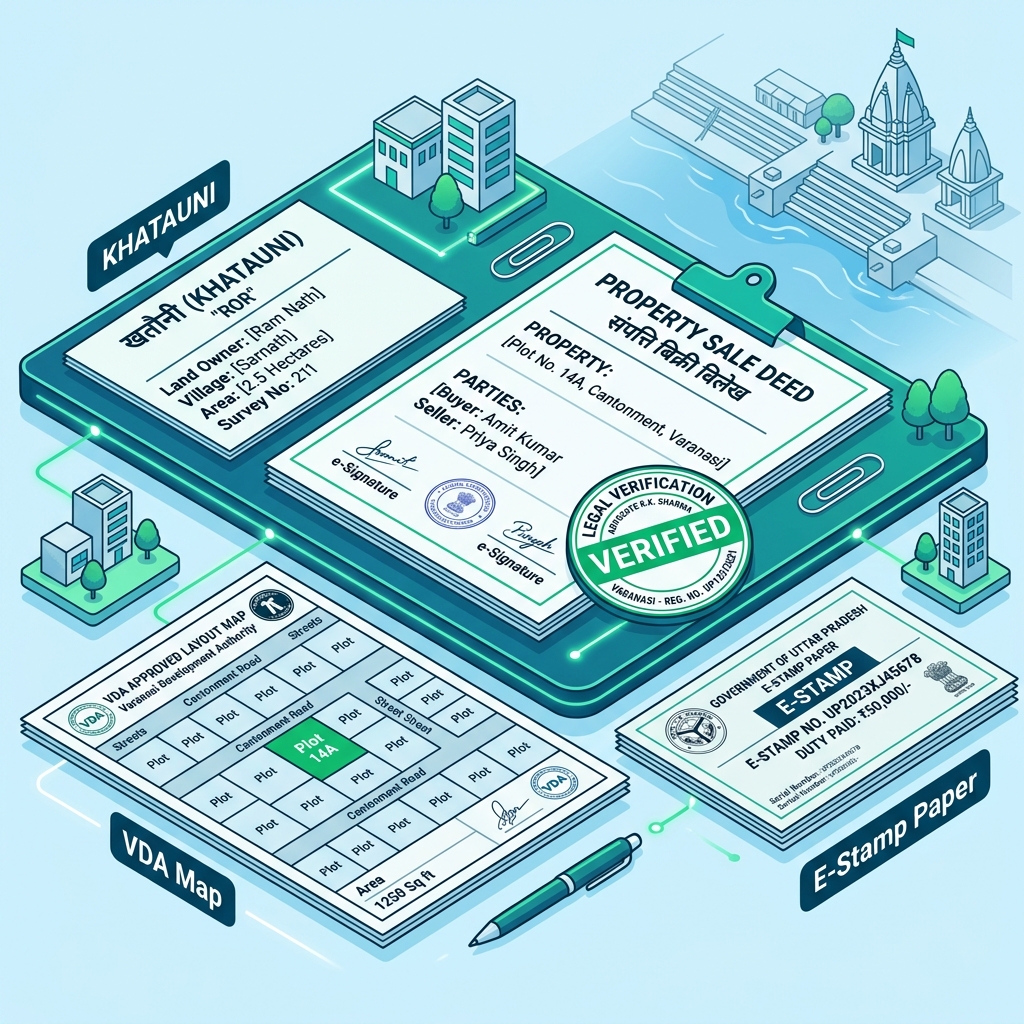
Varanasi is one of the oldest continuously inhabited cities on earth, and its property records carry that history. Land here has passed through generations of undivided families, temple trusts, and endowments, long before "khata" and "khasra" numbers were ever digitised. That's exactly why a generic, pan-India property checklist can leave a buyer exposed in Varanasi in ways it wouldn't in a planned city like Noida or Gurugram.
This guide covers every document you actually need — from the seller's title chain to your own KYC paperwork — and then goes further, into the local traps (temple trust land, riverside construction bans, undivided havelis) that catch out buyers who only followed a generic list.
📋 Quick Answer: The Full Document Checklist
From the Seller / About the Property
- Sale deed and complete chain of title: Mother deed and all prior deeds (ideally traced back 30 years).
- Khatauni and Khasra copy: Latest revenue record from the UP Bhulekh portal (upbhulekh.gov.in).
- Encumbrance Certificate (EC Form 15/16): Nil-lien proof from IGRSUP (igrsup.gov.in).
- Mutation (Dakhil-Kharij / दाखिल-खारिज) record: Tehsil revenue entry confirming current seller's name.
- VDA-approved layout status: VDA colony sanction letter or self-certification for small plots (via vdavns.com).
- Sanctioned building map & Completion/Occupancy certificate: Mandatory for built-up structures.
- Latest property tax receipt: Paid receipt from Nagar Nigam Varanasi (nnvns.org.in).
- Relevant NOCs: Housing society NOC, Bank Loan Closure NOC (if mortgaged), Fire/Pollution NOC where applicable.
- UP RERA registration certificate: Mandatory for builder townships/under-construction projects (up-rera.in).
- Registered Power of Attorney: Registered POA with direct owner consent (not merely a notary copy).
From You, the Buyer
- PAN Card: Mandatory for any property transaction above ₹10 lakh (TDS verification if > ₹50 lakh).
- Aadhaar Card: Mandatory biometric verification at Sub-Registrar desktop.
- Address Proof & Photographs: Valid ID proof + 4 passport-size photographs.
- Loan Sanction Letter: Bank sanction letter and income paperwork if financing.
On Registration Day
- Original IDs: Buyer, seller, and 2 witnesses (Gawah).
- E-stamp Receipt: SHCIL e-stamp paper receipt.
- Registration Fee Receipt: 1% IGRSUP registration fee payment challan.
- Passport Photos: All parties present at Sub-Registrar Sadar/Pindra/Rajatalab.
The rest of this guide explains what each of these actually means, where to get it in Varanasi specifically, and the risks that are unique to this city.
Why Varanasi Needs a More Careful Checklist Than Most Cities
Three things make Varanasi's property paperwork trickier than average:
- Layered ownership history Old-city neighbourhoods like Lanka, Assi, and the ghats have parcels that have been in the same family — or the same temple trust — for well over a century, often without a clean, individually-recorded title.
- Heavy overlay of religious and endowment land Math (मठ) and temple trust land, and in some pockets, Waqf-registered land, is sometimes sold as if it were ordinary private property.
- Development and heritage restrictions layered on top of ownership Even when title is clean, the Varanasi Development Authority (VDA) and heritage/riverfront rules can restrict what you're allowed to build or rebuild — something a sale deed alone will never tell you.
Keep this in mind as you go through the list below: in Varanasi, clean title and buildable/approved status are two separate questions, and you need to verify both.
Part 1: Documents About the Property (Seller-Side)
1. Sale Deed and the Chain of Title
The sale deed is the legal instrument that actually transfers ownership from seller to buyer, and it's the document every subsequent claim to the property rests on. Don't stop at the most recent sale deed — ask for the mother deed and every sale deed in the chain before it. For resale property in the old city especially, try to trace ownership back a full 30 years. A short or broken chain is one of the most common ways a defective title stays hidden until after money has changed hands.
2. Khatauni and Khasra (UP Bhulekh)
In UP's revenue system, the Khatauni (खतौनी) is the ownership and revenue record naming the legal holder of a plot, and the Khasra/Gata (खसरा/गाटा) number identifies the specific parcel. Both are available free on the state's Bhulekh portal at upbhulekh.gov.in:
- Select district Varanasi.
- Choose your tehsil — Varanasi Sadar, Pindra, Arajiline, Kashi Vidyapeeth, or Sewapuri.
- Select the village (Gram / Mauza).
- Search by Khasra/Gata number, or by owner name if you don't have the number.
- Cross-check that the name shown matches your seller exactly.
The portal also has a "plot sale status" lookup, which is worth running separately — it flags whether the plot shows as already sold or under restriction. Treat Bhulekh as your starting point, not your final word: it tells you who the revenue record currently names as owner, but not whether that property is mortgaged, disputed, or under a court order. That's what the next document is for. Learn more in our UP Bhulekh Varanasi Guide.
Need Legal Help Preparing Your Property Documents File in Varanasi?
PropertyPass Legal Desk checks Mother Deeds, Bhulekh Khatauni records, IGRSUP Encumbrance Certificates, and VDA approvals to assemble a 100% dispute-free buyer dossier before registration.
3. Encumbrance Certificate (EC)
The EC — sometimes listed on government portals as the "Twelve Years" certificate, and known informally as Barah Sala (बारह साला) — lists every registered transaction against a property: sales, mortgages, gift deeds, court attachments. Apply through igrsup.gov.in under Citizen Online Services:
- Log in or register with your mobile number and email.
- Enter district Varanasi, tehsil, village, and the survey/plot details.
- Choose your search period (12 to 30 years).
- Upload the title deed and an ID proof.
- Pay the fee (roughly ₹100–₹500, depending on district and period).
- Download the digitally signed EC once processed.
The "twelve years" default is a minimum, not a recommendation. For anything in the old city, or any property that's changed hands more than once, ask for a 30-year EC — a shorter search window is exactly how older disputes and undischarged mortgages stay invisible. Read our step-by-step Varanasi EC Guide.
4. Mutation (Dakhil-Kharij) Records
Mutation is the update of revenue records after a sale, gift, or inheritance, processed at the Lekhpal/Tehsil level. If the Khatauni still shows a previous owner's name — even though your seller claims ownership through inheritance or an earlier purchase — that's a pending mutation, and it's a real title risk, not a paperwork formality. Confirm mutation is complete before you proceed. Check our Varanasi Mutation Guide for detailed steps.
5. VDA Layout/Colony Approval Status
The Varanasi Development Authority governs planned development across a large area that includes the city and surrounding villages. Before buying any plot, check whether the colony or layout itself is VDA-approved, using the checker at vdavns.com or our VDA Approved Hub. An unapproved colony can mean registration difficulties, loan rejections, or future regularisation and demolition risk — even if the seller's individual title is otherwise clean. Very small plots (up to 100 sq. m. residential or 30 sq. m. commercial) qualify for a simplified self-certification route rather than full map approval, so don't assume "no formal approval on file" always means a problem — but do get it confirmed either way.
6. Sanctioned Building Plan, Completion and Occupancy Certificates
For any constructed property, ask for the VDA/Nagar Nigam-sanctioned building map and confirm the actual structure matches it. Deviations — an extra floor, an extended balcony — can mean compounding penalties or, in serious cases, demolition exposure that transfers to you as the new owner. A completion certificate (and occupancy certificate, where applicable) confirms the construction was signed off as per the approved plan, which also matters for getting utility connections in newer developments.
7. Property Tax Receipts (Nagar Nigam Varanasi)
Get the latest paid property tax receipt from Nagar Nigam Varanasi (NNVNS, via nnvns.org.in), and confirm there are no outstanding dues. It's worth being clear on this distinction: VDA approves layouts and construction; Nagar Nigam handles municipal tax and civic services. Buyers sometimes get an NOC from one and assume it covers the other — it doesn't, and you may need clearances from both bodies depending on the property.
8. NOCs — Society, Bank, Fire/Pollution
- Society NOC, for flats or group housing: Confirms no pending maintenance dues or internal disputes.
- Bank NOC (Lien Release Certificate): Mandatory if the seller currently has an active home loan on the property. Skip this and you inherit the bank's charge along with the property — the EC will show it, but only if you've actually pulled one.
- Fire/Pollution NOCs: Mainly relevant for commercial property or larger group housing projects.
9. UP RERA Registration (for Builder / Under-Construction Property)
For any project still under construction, check its registration on the official UP RERA portal (up-rera.in). RERA registration is meant to guarantee a defined delivery timeline and escrow-protected funds — but treat a "RERA registered" badge in a brochure as a starting point, not proof. UP RERA has itself flagged a large number of older-registered projects where promoters never uploaded the sanctioned map or land-ownership documents to the portal. Check that the actual documents are visible on the RERA listing for that specific project, not just that a registration number exists.
10. Power of Attorney — Read This Before You Rely on One
If the person selling to you isn't the recorded owner but is acting "on behalf of" the owner via a Power of Attorney, be careful. The Supreme Court's ruling in Suraj Lamp & Industries v. State of Haryana (2011–12) settled that a sale carried out purely through a Power of Attorney — without an actual registered sale deed — does not legally transfer ownership. A genuine POA used for management or to authorise someone to execute a registered sale deed on the real owner's behalf is still valid; what's not valid is treating the POA document itself as a substitute for title.
Before proceeding with a POA deal:
- Confirm the POA is registered at the Sub-Registrar office, not merely notarised.
- Confirm it explicitly authorises sale, not just management or maintenance.
- Confirm it hasn't been revoked and the grantor is alive.
- Where possible, have the actual owner ratify or co-sign the transaction directly.
Part 2: Your Own Documents as the Buyer
- PAN Card: Mandatory under Income Tax rules for any immovable property transaction above ₹10 lakh (TDS 26QB applicable for deals above ₹50 lakh).
- Aadhaar Card: Mandatory for biometric Aadhaar verification at the Sub-Registrar office (UP mandate from Feb 2026).
- Valid Address Proof: Passport, Voter ID, or Driving Licence.
- Passport-Size Photographs: 4 recent colored photos for registry forms.
- Loan Sanction Letter: Bank sanction letter and supporting income/KYC documents if financing the purchase.
NRI Buyers Note: If you're an NRI buying property in Varanasi, the same core checklist applies, with added FEMA compliance and restrictions on buying agricultural land — factor in extra time for document attestation at the Indian Embassy and remote verification.
Home Loan Note: If you're taking a home loan, expect the bank's panel lawyer to re-verify much of this list independently. That's not a duplication to skip — a bank's rejection of a title, even after you're satisfied with it, is a major warning sign worth taking seriously.
Part 3: What Happens on Registration Day
- Appointment Slot: Book an online appointment through IGRSUP for the Sub-Registrar's office having jurisdiction (Sadar, Pindra, or Rajatalab).
- E-Stamp Purchase: Purchase non-judicial e-stamp paper for the calculated stamp duty value via the IGRSUP-linked SHCIL portal.
- Carry Originals: Bring original IDs of buyer, seller, and two witnesses (Gawah), plus the sale deed draft, EC, and fee receipts.
- Biometric Verification: Biometric thumbprint scan and photo capture of buyer, seller, and witnesses are completed at the Sub-Registrar desktop.
- Fee Payment & Presentation: Pay the 1% registration fee challan and submit the document presentation file.
- Collection: Collect your registered sale deed copy (certified digital copies typically issue within 1–3 working days).
Part 4: What It Will Cost — Stamp Duty and Registration in UP
Both stamp duty and registration fee are calculated on whichever is higher: the government-notified circle rate or the actual transaction value. Circle rates vary by locality and even by specific Khasra number in Varanasi — calculate exact numbers using our Stamp Duty Calculator and Circle Rate Finder before budgeting.
| Buyer Category | Stamp Duty | Registration Fee |
|---|---|---|
| Male (sole owner) | 7% of property value | 1% |
| Female (sole owner) | 6% (with additional rebate on properties up to set threshold) | 1% |
| Joint ownership (male + female) | 6.5% of property value | 1% |
| Gift/transfer between blood relatives | Flat ₹5,000 + ₹1,000 processing | Capped at ₹20,000 |
A caution on the women's rebate specifically: Different official notifications and lenders currently describe this benefit differently — some cite a flat rebate on smaller-value properties, others a percentage rebate up to a much higher threshold. These thresholds get revised, so confirm the exact figure applicable to your transaction using the IGRSUP calculator before you finalise your budget.
Part 5: Varanasi-Specific Risks a Generic Checklist Won't Flag
This is where most "documents required" articles stop short — and where buyers in Varanasi actually get caught out:
1. Temple Trust (Math) & Endowment Land
Parts of the old city, Lanka, and Assi include land held by religious trusts rather than individuals. A trust cannot be sold like ordinary private property without the trust deed and proper trustee authorisation — verify this specifically, don't assume a sale deed alone settles it.
2. Waqf-Registered Land
Some parcels are classified as Waqf property and are sometimes sold as if privately owned. Only a Tehsil-level classification check can confirm this correctly — it won't always be obvious from a Bhulekh printout.
3. Undivided Family Property & Old Havelis
Multiple co-heirs holding a single property is common in Varanasi's older residential pockets. A sale by one heir without the knowledge or consent of the others is a recurring dispute pattern — confirm every legal heir has signed off, not just the person you're dealing with.
4. The 200-Metre Ganga Riverbank Zone
Following building-safety concerns in the old city, VDA has laid out specific rules for repair and reconstruction within 200 metres of the Ganga riverbank — some maintenance work is permitted without prior approval, but significant reconstruction is not. Separately, a broader national floodplain rule restricts fresh construction within 100 metres of the river. If you're buying anything near the ghats, confirm the property's exact status with VDA before you commit, not after.
5. Heritage & Monument Buffer Zones
Areas near protected monuments — including around Sarnath and the wider Kashi Vishwanath corridor — carry construction and modification restrictions tied to their protected status (ASI 100m/300m buffer rules).
6. Boundary Overlaps in Dense Mohallas
In closely built neighbourhoods such as Sigra, Shivpur, and Bhelupur, informally understood boundaries between neighbours don't always match the official Bhu-Naksha map. A site visit and a map cross-check both matter here.
7. Undisclosed Acquisition Notices
Land along active development corridors — Ring Road expansion and other VDA project areas — can carry acquisition notices that a seller may not proactively mention. Ask directly, and check with VDA if the property sits anywhere near an active corridor.
Part 6: Documents by Property Type, at a Glance
| Property Type | Standard Checklist, Plus |
|---|---|
| Resale plot | Full 30-year title chain; Khatauni updated in current owner's name; VDA colony-approval status. |
| Resale flat or house | Completion/occupancy certificate; society NOC; cleared maintenance dues. |
| VDA-allotted plot or flat | Allotment letter; VDA payment/EMI ledger (via PMS portal); possession letter. |
| Under-construction (builder) project | UP RERA certificate with documents actually visible on portal; builder-buyer agreement; construction-linked payment schedule. |
| Agricultural land converted for residential use | Land-use conversion order (Section 143/80 SDM order) from competent revenue authority, in addition to standard title documents. |
Part 7: Mistakes That Cost Buyers Real Money
- ⌠Treating a Bhulekh printout as sufficient on its own — it shows the last recorded owner, not existing loans or pending court cases against the property.
- ⌠Accepting a photocopied or unregistered Power of Attorney at face value — Supreme Court ruled GPA alone does not transfer legal title.
- ⌠Trusting a "RERA registered" claim without checking that actual sanctioned documents are uploaded to the project's RERA listing.
- ⌠Paying token or advance money before the Khatauni name-match has been independently confirmed.
- ⌠Assuming a colony is VDA-approved just because neighbouring plots already have houses built on them.
- ⌠Skipping an in-person Tehsil-level check for old-city or riverside property — this is precisely where digital portals routinely miss trust-land, Waqf classification, and boundary disputes.
Frequently Asked Questions
What is the single most important document when buying property in Varanasi?
No one document is sufficient on its own. The sale deed establishes the chain of ownership, the Khatauni confirms the current revenue record, and the Encumbrance Certificate confirms the property is free of undisclosed loans or claims — you need all three together, not any one in isolation.
Is checking UP Bhulekh online enough, or do I still need an in-person verification?
Bhulekh and IGRSUP cover most standard digital verification. But for old-city, riverside, or trust-land properties, a physical Tehsil-level check is often the only way to catch issues like Waqf classification or undocumented family disputes that don't show up cleanly online.
How do I check if a colony in Varanasi is VDA-approved?
Use the approved-colony checker at vdavns.com/colony. Very small plots may qualify for simplified self-certification instead of full layout approval.
What is the current stamp duty for property registration in Varanasi?
As of 2026, it's 7% for male buyers, 6% for sole female ownership, and 6.5% for joint ownership, plus a flat 1% registration fee — calculated on whichever is higher between the transaction value and the government circle rate. Confirm the exact current figures, including any applicable women's rebate, on the IGRSUP calculator before budgeting.
Can NRIs buy property in Varanasi?
Yes, subject to FEMA regulations, with restrictions on purchasing agricultural land. The core document checklist is the same, with extra time typically needed for attestation and remote verification.
What extra documents does a bank ask for when I'm taking a home loan?
Beyond the standard checklist, expect the bank to want the sanctioned building plan, its own independent EC pull, and a review by its panel lawyer — who will re-verify much of this list regardless of what you've already gathered.
Is it safe to buy property near the Ganga ghats in Varanasi?
It can be, but it needs extra verification. Properties within 200 metres of the riverbank fall under specific VDA repair and reconstruction rules, and a broader 100-metre floodplain restriction on fresh construction also applies. Confirm the exact zoning status with VDA before you commit, rather than after.
How long does full document verification take?
When documents are already in order, verification is usually straightforward. It's incomplete records, pending mutations, or contested family ownership — common in Varanasi's older neighbourhoods — that turn a simple check into a weeks-long process.
Before You Sign Anything
Every document on this list is checkable — but cross-referencing a sale deed, a 30-year EC, a Khatauni, VDA approval status, and a Tehsil-level trust/Waqf check is exactly the kind of work that's easy to under-do when you're excited about a property and eager to close. If you'd rather have this verified independently before you commit any money, PropertyPass Legal Desk runs fixed-price document verification — sale deed, Khatauni, EC, and VDA status checked and reported back to you in writing.
Get Your Property Document File Verified in Varanasi
Send your property details or document copies on WhatsApp. PropertyPass Legal Desk will audit Mother Deeds, Bhulekh Khasra records, IGRSUP deed history, and VDA approvals before you pay any advance.
Fast response within 30 mins • Confidential & Official Audit
Written by PropertyPass Legal Desk
Dedicated to making Varanasi real estate safer through rigorous verification and expert guidance. Our legal team works to ensure you invest in verified plots only.