UP Bhulekh Varanasi: Check Land Records Online (2026 Guide)
Bhulekh Desk @ PropertyPass
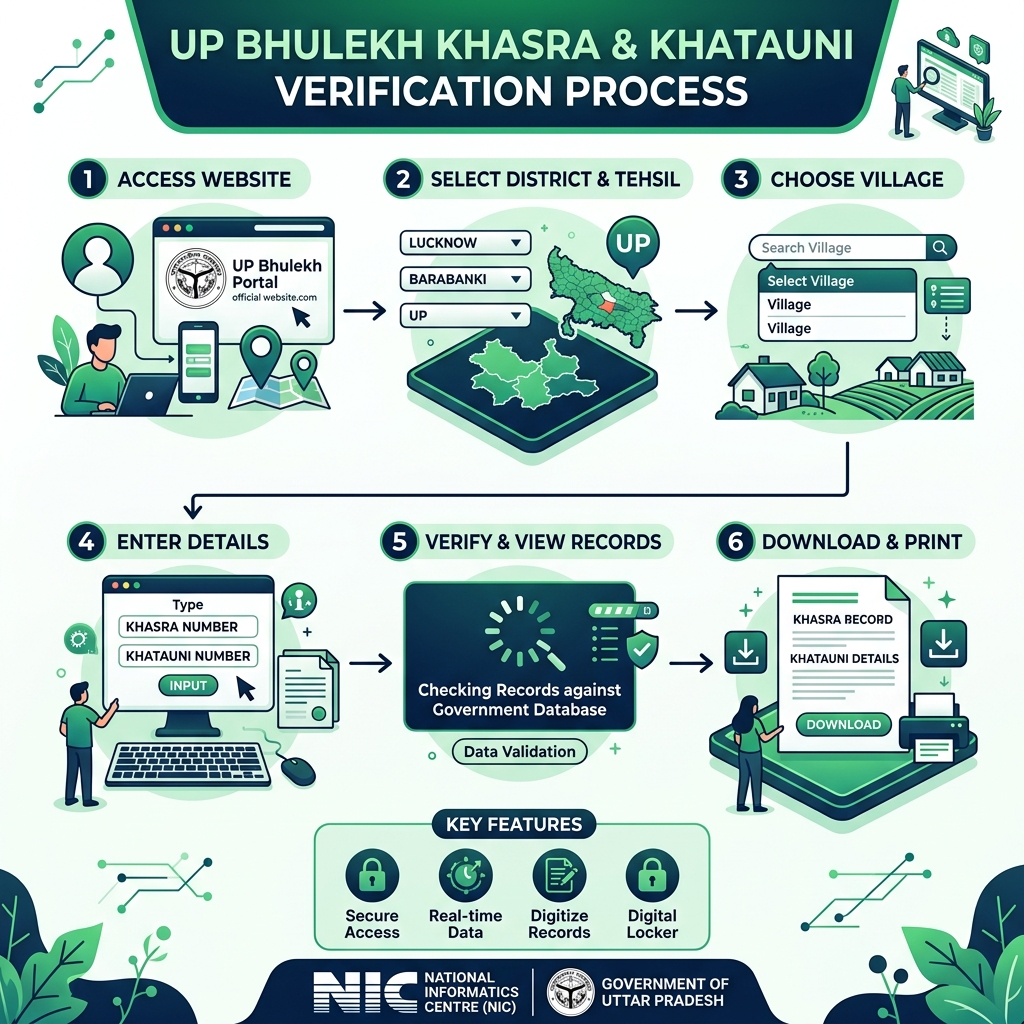
Buying a plot in Sewapuri, checking your ancestral share in Pindra, or just confirming your name is correctly recorded after a registry in Varanasi Sadar — all of it starts with one government portal. This guide walks through exactly how to check land records for Varanasi district on UP Bhulekh, what each document means, and the mistakes that most often trip people up.
What Is UP Bhulekh, in Plain Terms
UP Bhulekh (upbhulekh.gov.in) is the Uttar Pradesh Board of Revenue's official digital land record system. "Bhu" means land, "Lekh" means record — together, it's simply the state's written record of who owns what. Before this went online, anyone wanting to check a plot's ownership in Varanasi had to travel to the tehsil office, request the register, and often wait days for a clerk to pull the file. Today the same record is available for free, in minutes, from a phone or laptop.
For Varanasi specifically, records are organised under the district's three tehsils — Varanasi Sadar, Pindra, and Rajatalab — and then by village within each tehsil. Every plot search on the portal starts by narrowing down to these three levels: district → tehsil → village.
Why This Matters More in Varanasi Than You'd Think
Varanasi is one of the fastest-changing property markets in eastern UP — rapid urban expansion around the Ring Road, airport-adjacent villages in Pindra turning from farmland into residential colonies, and a steady flow of ancestral land being divided among heirs. That combination creates exactly the conditions where land disputes happen: unclear boundaries, incomplete mutations after inheritance, and land still classified as agricultural even though it's being sold as a residential plot.
Checking the record before you pay a rupee — not after — is what prevents most of this. A five-minute search tells you three things a seller might not volunteer: who is actually the recorded owner, whether the plot carries a dispute flag, and whether the land is even legally classified for the use you intend.
The Four Documents You'll Encounter
| Document | What It Tells You |
|---|---|
| Khatauni | The ownership record — who holds the land, and what share |
| Khasra | Plot-level detail — area, boundaries, land type (agricultural, abadi/residential, banjar) |
| Gata number | The unique numeric ID for a specific plot — the most reliable thing to search by |
| Bhu-Naksha | The digital map showing the plot's actual boundaries against neighbouring land |
💡 A Khatauni tells you who; a Khasra tells you what; Bhu-Naksha tells you where exactly. For a proper check before buying, you want all three, not just one.
Step-by-Step: Checking Khatauni (Ownership Record) for a Varanasi Plot
- Go to upbhulekh.gov.in. Type the address directly — don't search for it, since several lookalike sites copy government portals and show outdated or fake data.
- Click "Khatauni (Adhikar Abhilekh)" on the homepage — this is the ownership-record section.
- Enter the captcha exactly as shown. If it's unreadable, refresh it rather than guessing.
- Select District → Tehsil → Village. For Varanasi, choose "Varanasi" as the district, then pick Sadar, Pindra, or Rajatalab depending on where the plot is. Getting the village wrong is the single most common reason a search fails — several villages across the three tehsils have similar-sounding names.
- Search using one of three fields: Khata number, Gata/Khasra number, or the owner's name. If you have a Gata number from an existing document, use that — it removes any ambiguity from spelling.
- Review the result. You'll see the owner's name, the Gata number, area, land classification, and any recorded remarks.
- Download or print the record for your own reference.
One caution: What you download here is an informational copy. It's fine for your own due diligence, but if you're taking this to a bank for a home loan or using it during registration, you'll need a certified copy, which is issued (for a small fee) by the tehsil revenue office.
Need Help Reading UP Bhulekh Records for Your Varanasi Plot?
Bhulekh remarks (Tippani), bank mortgage entries, and court stay orders can be hard to decode. PropertyPass Legal Desk audits Tehsil Bhulekh extracts and provides a clear status report.
Searching by Owner Name (When You Don't Have a Gata Number)
This is the path most families use for ancestral land. A few things to know:
- Names in old revenue records often follow older spellings — try a couple of variants if the first search returns nothing.
- Land inherited but not yet formally transferred will still show the deceased or previous owner's name, because the ownership record only updates after "mutation" (Dakhil-Kharij) is completed at the tehsil.
- Once you find a matching name, cross-check the Gata number shown against any paperwork you already hold, so you're confident it's the correct plot and not a different person with the same name.
Checking Khasra Details and Land Classification
The Khasra tells you what the land actually is on paper, which matters a lot if you're planning to build. Land recorded as "Krishi" (agricultural) can't simply be treated as residential — using or selling it that way without conversion can create registration and loan problems later. Search using the Khasra/Gata number tab (same district–tehsil–village flow as above), and check the classification field in the result before you go further.
Checking Boundaries on Bhu-Naksha
Ownership on paper is only half the picture — boundaries matter just as much, especially with the amount of land subdivision happening around Varanasi's outskirts.
- Visit upbhunaksha.gov.in (a separate portal from Bhulekh).
- Select district (Varanasi), tehsil, and village from the panel on the left.
- Enter the Gata number to highlight the plot on the map.
- Compare the mapped boundary against the physical plot you've been shown — this is where encroachment or boundary mismatches show up.
- Download the plot map as a PDF for your records.
Checking for Disputes and Mutation Status
Before paying any advance, look for two things in the Khatauni record:
- Dispute notation — if a plot has an active revenue or court dispute attached, it will carry a remark in the record. Buying into a disputed plot means inheriting that dispute.
- Mutation status — if a sale or inheritance hasn't been formally updated, the record still shows the earlier owner. This is common enough in Varanasi's older mohallas and villages that it's worth checking as routine, not just when something looks off.
If mutation is pending, the fix is to approach the tehsil (Sadar, Pindra, or Rajatalab, depending on the plot) and initiate or follow up on the Dakhil-Kharij process before the transaction goes further. Read our detailed Varanasi Mutation Guide for the full step-by-step process.
Common Problems and Quick Fixes
| Problem | Likely Cause | Fix |
|---|---|---|
| Portal won't load | Heavy server traffic | Try early morning or late evening |
| Captcha keeps failing | Misread characters | Refresh and re-enter carefully |
| "No record found" | Wrong village selected | Recheck tehsil and village — don't assume, verify |
| Owner name search empty | Spelling variation in old records | Try alternate spellings, or switch to Gata number search |
| Bhu-Naksha map not loading | Browser/extension issue | Use updated Chrome/Firefox, disable ad blockers temporarily |
A Quick Real-World Example
Say you're looking at a plot in Sewapuri (Varanasi Sadar tehsil) that's being sold as residential. You search the Khasra using the Gata number the seller gave you and find two things: the land is still classified as agricultural, and the recorded owner's name doesn't match the seller. That's two red flags in under five minutes — enough reason to pause and ask for the mutation and land-use conversion to be sorted before you go further, rather than finding out after money has changed hands.
Frequently Asked Questions
Is checking UP Bhulekh for Varanasi free?
Yes. Viewing and downloading the informational copy of Khatauni or Khasra records costs nothing. Only certified copies, issued by the tehsil office for legal use, carry a small fee.
What are the tehsils in Varanasi district?
Varanasi Sadar, Pindra, and Rajatalab. You'll need to pick the correct one before searching for a village.
Can I check Varanasi land records without a Gata number?
Yes, by owner name — though it's less precise, since names can have spelling variations in older records.
Do I need to log in to use UP Bhulekh?
No. Public record search doesn't require any login, OTP, or registration. If a website asks for an OTP to "view" your land record, it isn't the official portal.
What's the difference between Khatauni and Khasra?
Khatauni is owner-level — it lists everything a person or family holds. Khasra is plot-level — it details one specific parcel's area, boundaries, and classification.
UP Bhulekh Record Extract & Title Audit
Share your Khasra number and village name on WhatsApp. PropertyPass Legal Desk will audit official Tehsil Bhulekh extracts and issue a clear land status report.
Fast response within 30 mins • Confidential & Official Audit
Written by Bhulekh Desk @ PropertyPass
Dedicated to making Varanasi real estate safer through rigorous verification and expert guidance. Our legal team works to ensure you invest in verified plots only.