VDA Plot vs Private Colony Plot: Which Is a Better Investment in Varanasi?
PropertyPass Legal Desk
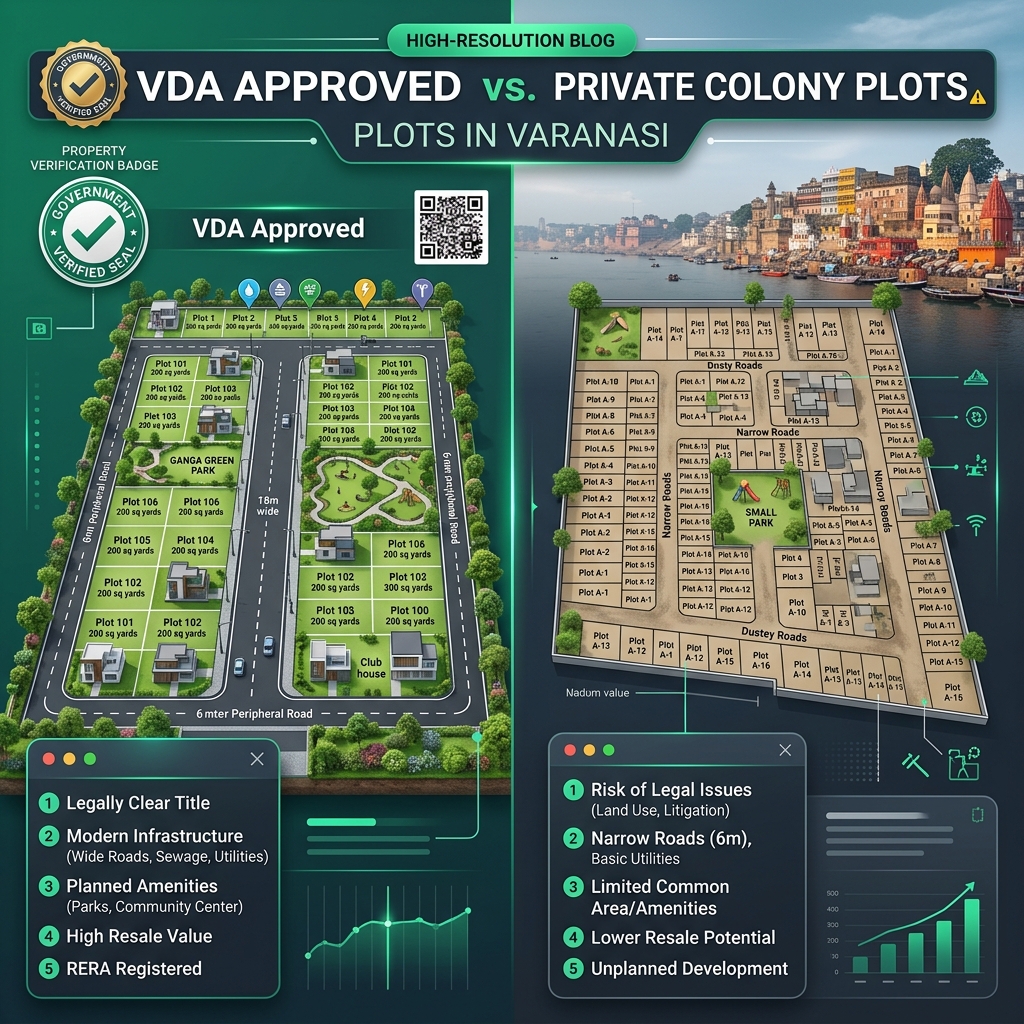
If you're planning to buy a plot in Varanasi, one question almost every buyer eventually asks is: should I buy a VDA (Varanasi Development Authority) plot, or a plot in a private colony? Both options come with their own advantages and risks, and the right choice depends on your budget, purpose (self-use vs. investment), and how much risk you're willing to take on.
In this guide, we compare VDA plots and private colony plots across every factor that matters — legal safety, pricing, infrastructure, loan eligibility, construction rules, and long-term returns — so you can make an informed decision.
âš¡ Quick Verdict Summary
- Choose a VDA Plot: If your priority is maximum legal safety, clear government title, easy bank loans, and a hassle-free long-term hold without boundary disputes.
- Choose a Private Colony Plot: If you need immediate possession, a specific central location, flexible payment installments, or custom gated amenities — provided you verify that the colony layout is officially VDA and UP RERA approved.
What Is a VDA Plot?
The Varanasi Development Authority (VDA) is a statutory body of the Uttar Pradesh government, established in 1974, responsible for the planned development of Varanasi and the surrounding region — a jurisdiction that spans roughly 793 sq. km and includes Mughalsarai along with hundreds of nearby villages.
VDA periodically launches residential, commercial, and industrial plot schemes, such as the Kallipur Residential Plot Scheme, and housing schemes in areas like Lalpur and Pandeypur. These plots are allotted under a government-approved layout with a registered master plan, which means the legal title and documentation are far less likely to run into disputes down the line.
What Is a Private Colony Plot?
Private colony plots are developed by private builders, real estate developers, or land aggregators. These colonies are typically located on the outskirts of the city or in fast-expanding suburban areas, and they offer a wide range of plot sizes, prices, and amenities — from budget layouts to premium gated communities.
Some private colonies do get their layout maps approved by VDA, but many others are developed on unauthorized or unapproved layouts — meaning there's no guarantee of proper road, sewer, and water infrastructure, and buyers may run into complications at the time of registry or resale.
VDA Plot vs Private Colony Plot: Side-by-Side Comparison
| Factor | VDA Plot | Private Colony Plot |
|---|---|---|
| Legal Safety | High — government-approved layout, clear title | Varies — some are approved, others are unauthorized |
| Registry & Mutation | Transparent process through the VDA portal | Depends entirely on the builder's documentation |
| Pricing | Usually below market rate (lottery/draw or auction) | Market-driven; can be higher depending on location |
| Infrastructure | Planned roads, drainage, water supply & parks per master plan | Depends on developer — excellent to minimal |
| Bank Loan Approval | Generally easy, since the title is clear | Not all colonies are loan-eligible |
| Possession Time | Can take longer (scheme allotment process) | Often immediate possession |
| Construction Rules | Must follow VDA building bylaws | Depends on developer or local municipal rules |
| Resale Value | Stable, steady long-term appreciation | Highly location-dependent — high growth or stagnant |
| Investment Risk | Low | Depends heavily on builder reputation & approval |
Advantages & Drawbacks of Buying a VDA Plot
✅ VDA Plot Advantages
- Clear title, minimal litigation risk: Recorded with the government, lowering land dispute risks.
- Easier bank loan approval: Quick loan sanctioning due to straightforward title verification.
- Planned infrastructure: Roads, drainage, streetlighting, and parks designed as part of master plan.
- Fair, transparent pricing: Allotted through lottery or e-auction, avoiding artificial developer markups.
- Government backing: Aligns with city infrastructure projects (highways, ropeway, expansion corridors).
⌠VDA Plot Drawbacks
- Allotment process takes time: Application, draw, and waitlist timelines can lag direct open market deals.
- Peripheral location in new schemes: Newer townships may be on peripheral edges with lower immediate rental demand.
- Procedural building map approval: Construction requires adhering strictly to VDA map approval and bylaws.
Buying a Private Colony Plot? Verify VDA Approval First
Token money pay karne se pehle specific private colony plot ka VDA layout approval status, Khatauni land-use (Section 143/80), and RERA registration verify karwayein.
Advantages & Risks of Buying a Private Colony Plot
✅ Private Colony Advantages
- Immediate possession & installment options: Instant possession with flexible payment schedules.
- Wider choice of locations: Pick plots closer to city center, main highways, or specific preferred pockets.
- Modern gated amenities: Gated security, landscaped parks, and clubhouses built by top developers.
âš ï¸ Private Colony Risks
- Unauthorized layout risk: Unapproved colonies face registry blockage, loan rejection, or demolition risks.
- Infrastructure delay risk: Promised internal roads and sewage connections rely heavily on builder intent.
- Complex title chain verification: Requires auditing 12–30 years of registered sale deeds and mutation history.
So, Which One Should You Choose?
Priority on Safety & Stability
If your priority is safety, a clear title, and a stable long-term investment, a VDA plot is the better choice — especially for first-time buyers or anyone planning to take a bank loan.
Priority on Specific Location & Custom Amenities
If you need a specific location, immediate possession, or customized amenities, and you're choosing a reputed, VDA/RERA-approved private developer, a private colony plot can also work well — as long as you verify the approval status.
Mixed Investor Strategy
A mixed strategy works well for portfolio investors: holding one VDA plot for safety and stability, and one approved private colony plot for location flexibility, to balance overall risk.
6 Documents You Must Check Before Buying Any Plot in Varanasi
📄 Mandatory Plot Legal Checklist
- Layout approval certificate: Issued by VDA or statutory town planning authority.
- Registered sale deed & chain of title: Complete unbroken ownership records for at least 12–30 years.
- Encumbrance Certificate (EC Form 15/16): Downloaded from IGRSUP confirming no active mortgages/liens.
- Land-use certificate (Section 143/80): SDM non-agricultural conversion order for residential use.
- Property tax receipts & mutation records: Verified on UP Bhulekh and municipal tax portal.
- RERA registration number: For private builder developer colonies under RERA purview.
Frequently Asked Questions (FAQs)
Q1. What is the main difference between a VDA plot and a private colony plot in Varanasi?
A VDA plot is allotted directly by the Varanasi Development Authority with government-approved layouts and guaranteed clear titles. A private colony plot is developed by a private builder or land aggregator; its legal safety and infrastructure depend on whether the developer secured VDA layout approval.
Q2. Are bank loans easier to get on VDA plots?
Yes. Banks quickly approve loans on VDA plots because the title is clear and unencumbered. Private colony plots require verification of VDA layout approval, non-agricultural land status (Section 143/80), and clear title deeds before banks will sanction a loan.
Q3. What happens if I buy a plot in an unapproved private colony in Varanasi?
Unapproved private colonies carry high risks — difficulty in getting mutation/registry, lack of municipal drainage/water connections, rejection of bank loans, and potential VDA regularization charges or demolition notices.
Q4. Which option offers better resale value in Varanasi?
VDA plots offer steady, low-risk long-term capital appreciation backed by city master plan connectivity. Private colony plots offer high growth if located in prime expanding corridors, but carry resale risk if layout approval is missing.
Q5. What documents must I check before buying a plot in Varanasi?
Check the VDA layout approval certificate, registered sale deed chain (12-30 years), Encumbrance Certificate (EC Form 15/16), UP Bhulekh Khatauni mutation status, SDM land-use conversion order, and UP RERA registration (for builder projects).
Final Verdict
Both VDA plots and private colony plots can be good investments in Varanasi, but a VDA plot generally offers lower risk and guaranteed legal safety, while a private colony plot offers more flexibility and location choice — provided the colony is properly approved. Whichever you choose, always get the documents thoroughly verified and consult a local property expert before finalizing your decision.
📜 Disclaimer
This blog is for general informational purposes only. Please verify all details with a legal advisor or property consultant before making any investment decision, and check the latest scheme information on VDA's official portal (vdavns.com).Need Official Verification for Your Plot in Varanasi?
Connect directly with PropertyPass Legal Team in Varanasi to verify layout approval, Khatauni land-use status, 30-year deed chain, and EC before paying advance.
Fast response within 30 mins • Official Verification
Written by PropertyPass Legal Desk
Dedicated to making Varanasi real estate safer through rigorous verification and expert guidance. Our legal team works to ensure you invest in verified plots only.