VDA Land Pooling Scheme Kya Hai? Kisano Ke Liye Fayde Aur Poori Process (2026 Guide)
PropertyPass Legal Desk
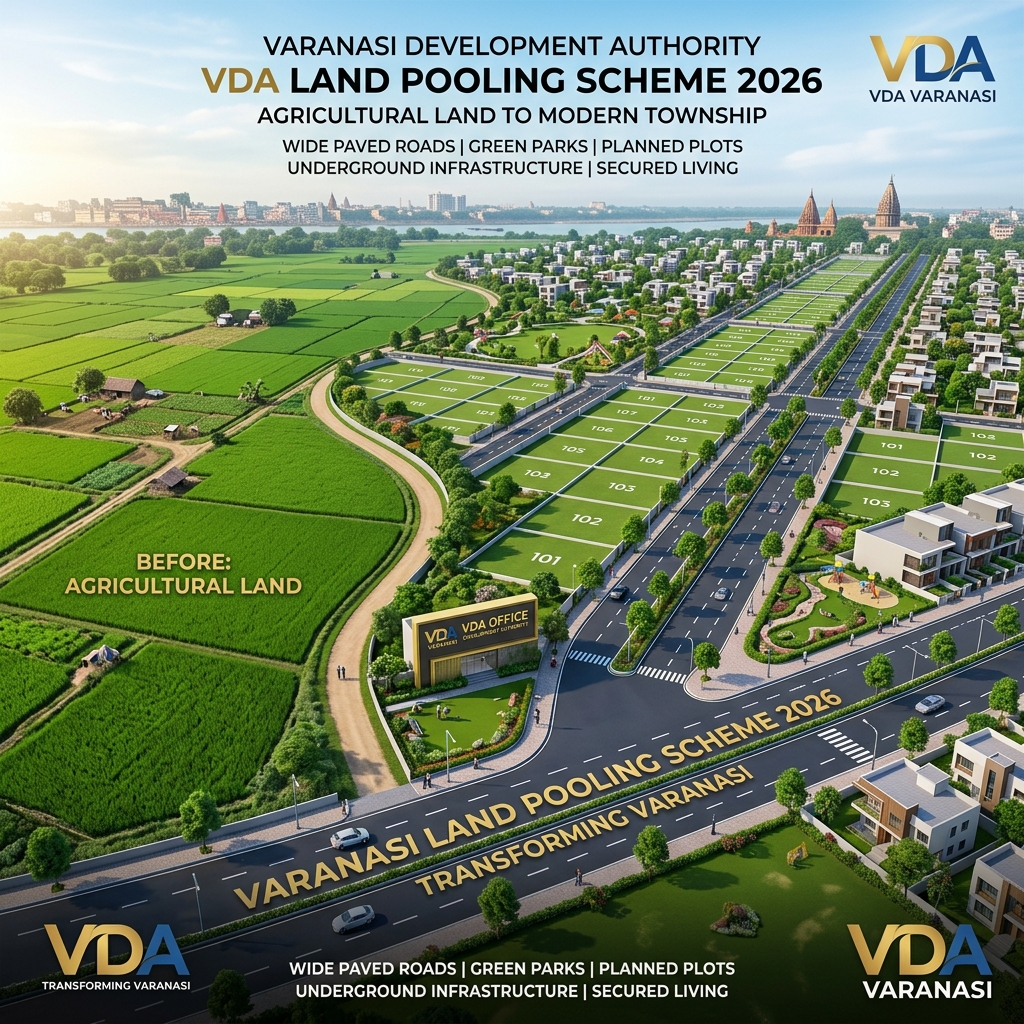
If you own agricultural land in the villages around Kallipur, Madhni, or Ganjari in Varanasi, you've probably heard the term "Land Pooling" being discussed everywhere — at the tea stall, in panchayat meetings, and now in official Varanasi Development Authority (VDA) notices. For decades, farmers dreaded the word "acquisition" because it meant losing their land for a one-time cash payment, often below market value, with years of legal disputes to follow.
The VDA Land Pooling Scheme changes that equation completely. Instead of taking your land away, the Varanasi Development Authority is inviting farmers to become development partners — you give raw agricultural land, and you get back a smaller but fully developed, high-value plot with clear title, roads, sewage, and electricity already in place.
💡 In Plain Language
This guide breaks down exactly what the scheme is, how it works, what farmers actually gain, and the step-by-step process to participate — so landowners can make an informed decision without legal jargon.
Quick Facts: VDA Land Pooling Scheme (2026)
| Feature | Details |
|---|---|
| Official Policy Approval | Approved in 134th VDA Board Meeting (29 June 2026) |
| Legal Foundation | UP Land Pooling Policy 2021, UP Town Planning & Dev Act 1973, Model Land Pooling Act (MoHUA) 2016 |
| Nature of Scheme | 100% Voluntary Partnership (No Compulsory Acquisition) |
| Township Initiative Milestone | First major township drive in 32 years (since Lalpur Awas Yojana 1994) |
| Flagship Townships Covered | 1. Anand Kashi (Kallipur - 250 acres) | 2. Rudra Vihar (Madhni - 165 acres) | 3. Sports City (Ganjari - 160 acres) |
| Tier 1 Return (< 10 Acres) | 30% land returned back fully developed with roads, sewage, electricity |
| Tier 2 Return (> 10 Acres) | 50% land returned back semi-developed |
| State Seed Funding | ₹400 Crore sanctioned by UP Government |
| Farmer Disbursement to Date | Nearly ₹950 Crore disbursed by VDA across township projects |
| Infrastructure Earmark | Over ₹200 Crore earmarked for infrastructure in each township |
What Is the VDA Land Pooling Scheme?
The Land Pooling Scheme is a landmark urban planning policy approved by the VDA Board in its 134th board meeting held on 29 June 2026, marking the first time VDA has used land pooling (instead of forced land acquisition) for large township projects. It is modeled on the Uttar Pradesh Land Pooling Policy 2021, the UP Town Planning and Development Act, 1973, and the Model Land Pooling Act (MoHUA), 2016.
In simple terms: farmers voluntarily hand over their agricultural land to VDA. VDA then develops that land — laying roads, drainage, sewer lines, and electricity infrastructure — and gives back a portion of the same land to the original owner as a ready-to-build, legally clear residential or commercial plot.
This is a sharp departure from the old "Awas Yojana" (housing scheme) model, where the government acquired land outright and farmers simply received a lump-sum compensation cheque — usually followed by years of court cases over "fair" valuation.
Notably, this is VDA's first major township initiative in 32 years, since the Lalpur Awas Yojana of 1994. The scheme is currently being implemented in three flagship VDA townships:
Kallipur (250 acres)
Madhni (165 acres)
Ganjari (160 acres, next to upcoming international cricket stadium)
Why Is VDA Choosing Land Pooling Over Land Acquisition?
Traditional land acquisition has become extremely difficult for urban development authorities across India — farmer protests, litigation, and delays often stall projects for decades. VDA officials have openly acknowledged this shift in strategy.
"The land pooling model turns landowners into genuine development partners rather than parties being dispossessed, so that the landowner, the authority, and the city all benefit together."
— Purna Bora, VDA Vice-Chairman
The scheme is backed by real financial commitment: the Uttar Pradesh government has sanctioned ₹400 crore in seed funding, and VDA has already disbursed nearly ₹950 crore to participating farmers as part of these township projects, with more than ₹200 crore earmarked for infrastructure in each township.
How the Land Pooling Formula Works: The Two-Tier Structure
This is the part every landowner needs to understand clearly, because the return you get depends on how much land you contribute.
Landowners Contributing Less Than 10 Acres
- You receive 30% of your original land back.
- The returned plot is fully developed — meaning roads, sewage, drainage, and electricity connections are already in place.
- You get a plot that is immediately usable or sellable on the market.
Landowners Contributing More Than 10 Acres
- You receive 50% of your original land back.
- The returned land is semi-developed (basic infrastructure exists, but some development work is still ongoing).
- Larger contributors get a bigger share of land, reflecting their bigger stake in the project.
ðŸ›¡ï¸ Two Statutory Protections Applied to Both Tiers
- Automatic land use conversion: Your land use classification changes automatically from agricultural to residential/commercial — no separate application, SDM conversion fees, or long bureaucratic processes required.
- Clear RERA-registered title: The returned plot comes with unambiguous, legally clean ownership registered under UP RERA, removing the risk of future title disputes.
Kallipur, Madhni Ya Ganjari Mein Land Verification Karwayein
Aapki zameen VDA Land Pooling notified zone mein aati hai ya nahi? Plot documents aur Khatauni status verify karwane ke liye hamare Varanasi legal desk se connect karein.
Top 6 Benefits for Farmers
1. No Development Charges on Returned Plot
Normally, when you construct on a plot and get your building map approved, you pay a "development charge" to the authority. Under this policy, that charge is completely waived for plots returned through land pooling — a direct financial saving for every participating farmer.
2. Massive Jump in Land Value
Raw agricultural land ("kachcha" land) sells for a fraction of what a developed residential or commercial plot commands. Once VDA lays roads, sewage lines, and electricity, and land use changes, the market value of your remaining share can be many times higher than what your entire original raw plot was worth.
3. No Forced Acquisition, No Legal Battles
Because participation is voluntary and structured as a partnership, farmers avoid the adversarial acquisition process, drawn-out compensation disputes, and years of litigation that have plagued land acquisition cases across Uttar Pradesh and India.
4. Ready Infrastructure, Zero Extra Investment
VDA bears the entire cost of building roads, sewer lines, drainage, and power infrastructure on the pooled land. You don't have to spend a single rupee developing your own plot before it becomes usable or sellable.
5. Legally Backed, Government-Funded Project
This isn't a private developer scheme with uncertain follow-through. It runs under the UP Land Pooling Policy 2021 and Model Land Pooling Act, backed by UP state government seed funding of ₹400 crore.
6. Long-Term Wealth Creation for Families
A developed plot in a planned township — complete with schools, hospitals, commercial centers, and hotels as in Anand Kashi Township — becomes a durable, appreciating family asset that supports future generations.
VDA Land Pooling Process: Step-by-Step Guide
Here's how the process typically works for a landowner in the notified project areas (Kallipur, Madhni, Ganjari, and other master-plan development corridors):
Step 1: Check if Your Land Falls in a Notified Zone
Land pooling currently applies to land within the development corridors defined by the Varanasi Master Plan 2031 — specifically Anand Kashi City (Kallipur), Rudra Vihar (Madhni), and Sports City (Ganjari). Visit the VDA office or website to confirm whether your khasra/plot number falls within a notified scheme area.
Step 2: Voluntary Consent and Documentation
You submit your consent along with land ownership documents (khatauni, khasra, sale deed, etc.) to VDA. Because the scheme is voluntary, there is no compulsion — but participation is what allows you to benefit from the pooling formula.
Step 3: Land Measurement and Categorization
VDA measures your contributed land and categorizes you into the applicable tier — below 10 acres or above 10 acres — which determines your return ratio (30% fully developed or 50% semi-developed).
Step 4: Land Use Conversion (Automatic)
Once your land is pooled into the scheme, the land use classification is automatically converted from agricultural to residential/commercial as per the master plan — no separate conversion application is required.
Step 5: Development Work by VDA
VDA carries out infrastructure development — internal roads, sewage systems, drainage networks, and electricity supply — across the pooled land parcel.
Step 6: Plot Allotment and Return
Once development is complete (or substantially complete for the semi-developed category), your share of the land is returned to you as a demarcated, RERA-registered plot with a clear title.
Step 7: Registration and Free Map Approval
When you're ready to build, your building map approval on the returned plot is processed without any development charge, since it was already covered under the pooling policy.
A Real Example: Anand Kashi Township, Kallipur
To understand how this looks in practice, consider Anand Kashi Township — VDA's flagship project under this policy, spread across 250 acres in Kallipur.
- It is planned as Varanasi's first theme-based gated city, inspired by Kashi's cultural heritage.
- The first phase includes over 300 residential plots, ranging from 72 sq m to 450 sq m.
- Planned facilities include hotels, hospitals, schools, group housing, and commercial establishments.
- Plots are being allotted through a transparent lottery system, with successful applicants getting plots at the base rate.
- RERA registration for the project is underway, with launch expected around July 2026.
- As of the policy's approval, landowners had already contributed over 45–55 acres across Kallipur and Madhni voluntarily under the land pooling model.
Comparison: Old Land Acquisition vs VDA Land Pooling Scheme
| Feature | Old Land Acquisition | VDA Land Pooling Scheme |
|---|---|---|
| Nature of participation | Compulsory | Voluntary |
| What you receive | One-time cash compensation | Developed / semi-developed land back |
| Legal disputes | Common, often multi-year court cases | Minimal — no forced taking |
| Land value after process | Compensation often below market rate | Developed plot value much higher than raw land |
| Development charges | Not applicable (land taken outright) | Waived on returned plot |
| Ownership after process | None — land transferred fully to authority | You retain a smaller, higher-value share |
| Infrastructure | Not your concern — land is gone | Built by VDA on your remaining share |
Legal Framework Backing the Scheme
Farmers should know that this isn't an ad-hoc arrangement — it's built on solid statutory foundations:
- Uttar Pradesh Land Pooling Policy, 2021
- UP Town Planning and Development Act, 1973
- Model Land Pooling Act, 2016 (Ministry of Housing and Urban Affairs, Government of India)
- Alignment with the Varanasi Master Plan 2031
This legal backing means the scheme has statutory legitimacy and isn't dependent on informal assurances from officials.
Frequently Asked Questions (FAQs)
Q1. Is participation in the VDA Land Pooling Scheme mandatory?
No. It is entirely voluntary. VDA is inviting landowners to opt in; your land is not being forcibly acquired.
Q2. What happens if I own less than 10 acres?
You will get back 30% of your original land, but it will be fully developed with roads, sewage, drainage, and electricity already provided.
Q3. What happens if I own more than 10 acres?
You will get back 50% of your land, though it will be semi-developed rather than fully finished.
Q4. Will I have to pay for converting my agricultural land to residential/commercial use?
No, land use conversion happens automatically once your land is pooled into a notified scheme.
Q5. Do I have to pay development charges when I later build on my returned plot?
No. Development charges on the returned plot are waived under this policy.
Q6. Which areas in Varanasi does this scheme currently cover?
Currently, it applies to land within Anand Kashi City (Kallipur), Rudra Vihar (Madhni), and Sports City (Ganjari) — all part of the Varanasi Master Plan 2031 development corridors. VDA may extend the policy to other notified zones in future.
Q7. Is my returned plot legally secure?
Yes. Returned plots come with clear title and are registered under RERA, reducing the risk of future ownership disputes.
Q8. How do I check if my land qualifies?
Contact the VDA office directly or check your khasra/plot number against the notified scheme boundaries published on the official VDA website (vdavns.com) or visit the VDA office at Varanasi.
Final Thoughts
For generations, farmers around expanding Indian cities have watched their agricultural land get absorbed into "development" while receiving little more than a compensation cheque and a sense of having lost out. The VDA Land Pooling Scheme flips that script — turning farmers into stakeholders in Varanasi's urban growth story, with tangible, higher-value, legally secure assets to show for it.
If your land falls within Kallipur, Madhni, Ganjari, or any future notified corridor under the Varanasi Master Plan 2031, it is worth visiting the VDA office or checking the official VDA website for the latest documentation requirements and application process before deciding whether to participate.
📜 Disclaimer
This article is for general informational purposes based on publicly available VDA press releases and official policy announcements as of September 2026. For land-specific eligibility, exact plot allotment, and legal documentation, always consult the Varanasi Development Authority office directly or a qualified property lawyer before taking any action.ðŸ›ï¸ Official VDA Contact Details
- Website: vdavns.com
- Vice-Chairman Office: 0542-2282455
- Secretary Office: 0542-2280326
- Email: vdavaranasi@gmail.com
Need Official Document Check for Land Pooling?
Connect directly with PropertyPass Legal Team in Varanasi to verify Khatauni, Khasra, VDA notified boundaries, and RERA registration status.
Fast response within 30 mins • Official Verification
Written by PropertyPass Legal Desk
Dedicated to making Varanasi real estate safer through rigorous verification and expert guidance. Our legal team works to ensure you invest in verified plots only.