How to Verify VDA Khatauni & Naksha? Complete Guide to Avoiding Fake VDA Layouts (2026)
PropertyPass Legal Desk
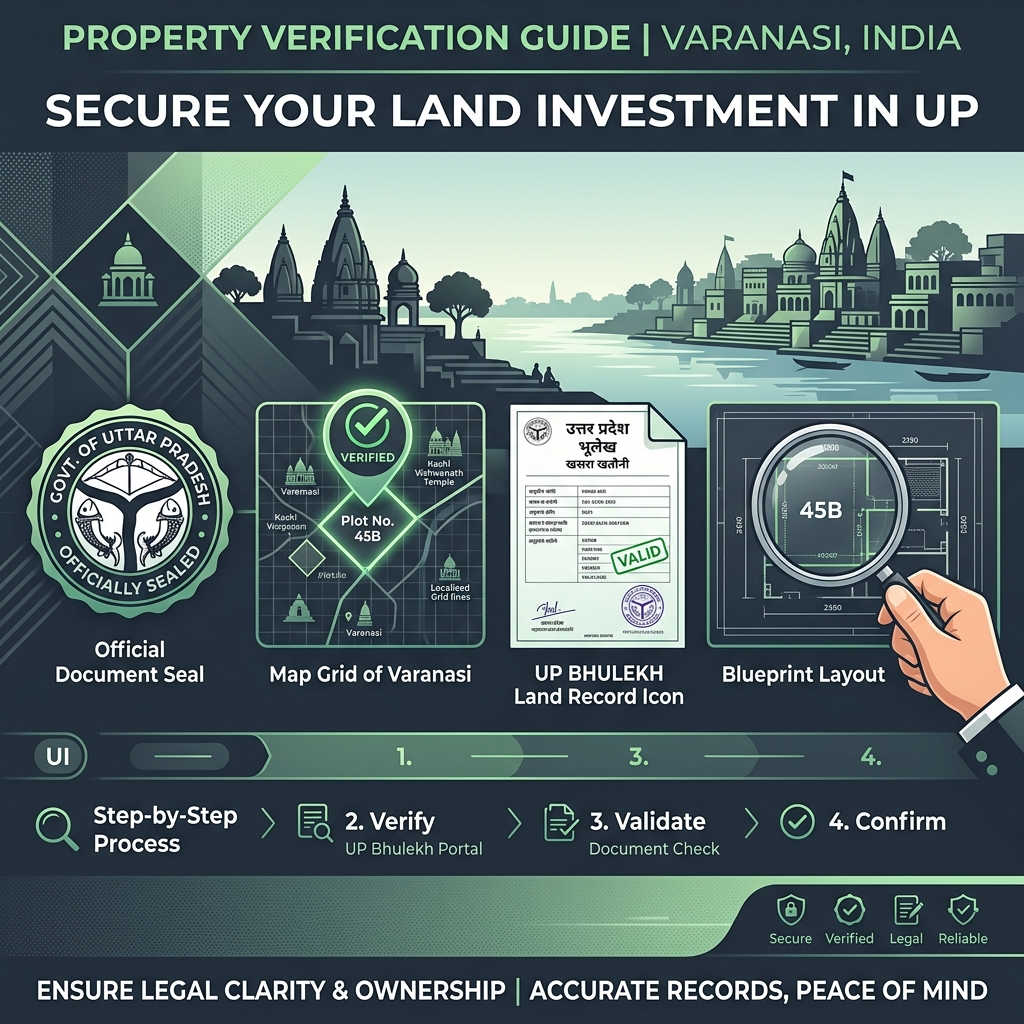
Land and plot prices in Varanasi have climbed sharply over the past few years. As demand has grown around the Ring Road, the corridor area, and new highway stretches, so has something else — fake and unauthorised plotting. Cutting farmland into plots without proper land-use conversion, or selling a scheme as "VDA-approved" when it isn't, has become one of the most common frauds buyers face in the city.
VDA's own enforcement teams have spent recent months bulldozing plotting schemes across several villages that went up without an approved layout or naksha — and every time, the message from the authority is the same: check the land use and approval status before you buy, don't just take the broker's word for it. The problem is that most buyers simply don't know where to check a khatauni or naksha, which portals to use, or what a fake layout actually looks like on paper.
This guide walks through the exact steps, with links to the official portals, so your hard-earned savings don't end up locked into an illegal plotting scheme.
What Is VDA, and Why Does It Matter?
The Varanasi Development Authority (VDA) was established on 19 August 1974. It's responsible for preparing the master plan, approving building and layout maps, deciding land use, and taking action against unauthorised construction across Varanasi city, Mughalsarai, Ramnagar, and roughly 850 surrounding villages — a jurisdiction of about 1,073 square kilometres in total. VDA's official website is vdavns.com.
Key Terms You Need to Know First
A lot of confusion in this process comes from mixing up terms that sound similar but mean different things. Here's a quick reference:
| Term | What it means |
|---|---|
| Khatauni | The official Record of Rights (RoR) for a piece of land — shows the owner's (khatedar's) name, the area (rakba), and the khasra number |
| Khasra / Gata number | The identification number of a specific field or plot, used to pull up its survey record |
| Bhu Naksha | The land map showing a plot's boundaries by khasra number — tells you where the plot is and what shape/size it is |
| Layout / Building Map (Naksha) | The official map VDA approves for a colony, plotting scheme, or building — this is different from the bhu naksha |
| Araji number | The older revenue identification number for a parcel of land within a mauja |
| Mauja | The village-level revenue unit in land records |
| Pargana | A revenue sub-division made up of several maujas |
| Land Use | The category assigned to land in the master plan — residential, agricultural, commercial, etc. |
How to Verify VDA Khatauni Online
Khatauni verification happens through UP's official land records portal, not through the VDA website directly — khatauni is handled by the Revenue Department.
🔠3 Critical Things to Check on Khatauni:
- ✓ Owner's name — does it match the person selling you the land (or the seller named in the draft sale deed)?
- ✓ Area (rakba) — does it match the area mentioned in the agreement?
- ✓ Land category — is it still listed as "agricultural," or has it been converted to residential?
If needed, also check the "Real Time Khatauni" (RTK) option — it reflects the most recent mutation status. On the same portal, use "Vaad Status" (dispute status) to check whether any court case or dispute is pending on the land.
To cross-check the land boundary map (bhu naksha), use the same khasra number on upbhunaksha.gov.in and match the plot's shape and size.
VDA Approved Colony Ya Khatauni Verification Mein Help Chahiye?
Token money dene se pehle land title, Khatauni, VDA illegal colony list audit, aur 30-year deed chain report ke liye hamare local Varanasi legal experts se WhatsApp par baat karein.
How to Verify VDA Naksha/Layout (4 Methods)
This is where most of the fraud happens, so it's worth cross-checking through more than one source.
📌 Method 1: Check VDA's Approved/Illegal Colony List
VDA publishes a public list of every authorised and unauthorised colony in Varanasi — this is the best first step.
- Go to vdavns.com/colony.
- You'll find three tabs — Approved, Illegal, and Developed Colonies.
- Match the colony name, araji number, mauja, and pargana against what's written in your sale deed or agreement.
- If the colony's name shows up under the "Illegal" tab, don't buy there — no matter how genuine the naksha looks.
- If the colony doesn't appear on either list (neither approved nor illegal), treat that as a warning sign in itself — contact VDA's Manchitra Suvidha Cell or helpline directly to ask.
🢠Method 2: Check the Individual Map Approval Database
If you want to verify the naksha for a specific apartment, group housing project, commercial building, or plot (not just a colony as a whole):
- Go to vdavns.com/approved-maps.
- Filter by Financial Year and Plot Sub Use (Residential Apartment, Group Housing, Commercial Building, etc.).
- Each entry shows the owner's name, plot area, floors, araji/mauja/pargana, and approval date — match this against the map the builder or seller has shown you. If the name or araji number doesn't match, be cautious.
💻 Method 3: Check Map Status on UPOBPAS
Uttar Pradesh's statewide online building permission system, UPOBPAS, also shows the status of a map application — submitted, approved, or rejected. VDA's own website links to this via "ONLINE UPOBPAS MAP STATUS." Ask the builder for the map application/approval number and confirm the status there.
ðŸ›ï¸ Method 4: Get Written Confirmation Directly From VDA
For anything involving a large amount of money (which land usually is), don't rely on the website alone:
- Visit VDA's Manchitra Suvidha Cell (Map Facilitation Cell) in person, or call the helpline 7518102822, to verify the map number.
- Ask for written confirmation by email: vda-varanasi@nic.in or vcvda.vns@nic.in.
- If needed, file an application under the RTI Act for a formal response — VDA's website has an RTI section.
âš ï¸ Watch Out for the "Compounding" (Shaman) Trap!
Sellers or brokers sometimes say, "There's no naksha right now, but it'll get compounded (shaman) later." Compounding is a fee-based process meant for minor construction deviations — it is not a guaranteed amnesty for any kind of unauthorised plotting. Don't rely on a promise that everything will "become legal later" for a scheme with no approved layout at all.
11 Red Flags of a Fake VDA Layout
Over recent months, VDA's enforcement teams have bulldozed several unauthorised plotting schemes spread across dozens of bighas in villages that went up without an approved layout or map. VDA's consistent message has been that buyers shouldn't rely on a broker's word alone and should verify land use and approval status themselves before purchasing. Cases of fraud through fabricated documents — where a genuine owner's identity is manipulated — also keep surfacing, which is why checking the seller's identity and the registry chain (via IGRSUP) matters just as much as checking the naksha.
Complete Checklist Before Buying Land
- ✓ Khatauni verified on upbhulekh.gov.in — name, area, and land category all match
- ✓ Vaad Status checked — no pending court case
- ✓ Bhu naksha on upbhunaksha.gov.in matches the plot's boundary and size
- ✓ Colony/layout found on VDA's Approved list at vdavns.com/colony
- ✓ Individual map approval confirmed at vdavns.com/approved-maps (where applicable)
- ✓ RERA registration checked on up-rera.in (for larger schemes/apartments)
- ✓ Registry and Encumbrance Certificate (EC) verified on igrsup.gov.in — seller is the actual owner, no loan/mortgage recorded
- ✓ Property tax receipt obtained from municipal corporation/VDA and matched to owner's name
- ✓ Visited the plot in person and spoken to neighbours/locals about it
- ✓ A property lawyer has reviewed all documents for large transactions
If You've Already Been Defrauded
If you've already put money into a fake layout, don't wait — use these channels without delay:
Important Government Portals — Quick Reference
| Task | Portal / Link |
|---|---|
| Verify khatauni / khasra | upbhulekh.gov.in |
| Bhu naksha (plot boundary map) | upbhunaksha.gov.in |
| VDA approved / illegal colony list | vdavns.com/colony |
| VDA individual map approvals | vdavns.com/approved-maps |
| VDA Master Plan 2031 | vdavns.com/master-plan |
| Verify registry / stamp / EC | igrsup.gov.in |
| Verify RERA project / promoter | up-rera.in |
| General grievance (CM Helpline 1076) | jansunwai.up.nic.in |
| VDA helpline & email | 7518102822 · vda-varanasi@nic.in |
Frequently Asked Questions (FAQs)
1. How long does it take to verify VDA khatauni and naksha?
Checking khatauni and bhu naksha online usually takes 10–15 minutes. Searching VDA's approved colony/map list takes just a few minutes too. Getting full written confirmation (via RTI or email) can take anywhere from a few days to about a week.
2. Do I need to verify the naksha separately even if the colony is VDA-approved?
Yes. A colony having an approved layout doesn't mean every later change inside it — like re-dividing a plot or extra construction — is automatically approved. For large transactions, cross-check the map for that specific plot as well.
3. If the seller has a registry, is the land automatically safe to buy?
Not necessarily. Verify the registry on IGRSUP to confirm the seller is the current owner, that the name matches the khatauni, that there's no recorded loan or mortgage, and that the layout/naksha is VDA-approved. A registry alone doesn't guarantee the plotting itself is legal.
4. What if the name on the khatauni looks old or doesn't match?
This usually means the mutation (namantaran) hasn't been updated. Check the "Real Time Khatauni" option, and ask the seller for proof of mutation. Don't move forward without an updated mutation record.
5. Is RERA registration always required for plots in VDA's jurisdiction?
Generally, yes for larger plotting schemes, group housing, or apartment projects (above a minimum area/unit threshold set by law). It may not apply to very small, individual land transactions. Confirm the exact applicability by searching the project on up-rera.in or asking a lawyer.
6. Does VDA approval apply to land in villages too, not just Varanasi city?
Yes. VDA's jurisdiction now includes roughly 850 surrounding villages in addition to Varanasi city. If a village falls within VDA's expanded boundary (Seema Vistar), any colony or plotting scheme there also needs VDA's layout approval. Check whether a village is on VDA's list via vdavns.com.
7. If money is already stuck in a fake layout, what are the chances of getting it back?
It varies case by case — it depends on the evidence available, whether the seller (and their assets) can be traced, and how quickly a complaint is filed. The sooner you file with VDA, RERA, and the police, the better your chances of recovery. Delays weaken the case.
Conclusion
Verifying VDA khatauni and naksha isn't complicated — you just need to know the right portals: upbhulekh.gov.in (khatauni), upbhunaksha.gov.in (bhu naksha), vdavns.com (layout/naksha approval), igrsup.gov.in (registry), and up-rera.in (RERA). Don't rely on any single one of these — cross-checking across multiple sources is what actually protects you. The money that goes into land is usually someone's life savings, so a few hours of due diligence is never wasted time — it's the most important investment you'll make in the whole transaction.
*Disclaimer: This article is for general informational purposes only and is not legal advice. Processes and rules on government portals can change over time, so confirm the latest details directly on the relevant portals before finalising any deal, and consult a property lawyer.*
VDA Khatauni & Naksha Legal Verification Desk
VDA layout approval check, khatauni verification, illegal colony list cross-checking, ya RERA compliance status ke liye PropertyPass legal desk se direct connect karein.
Fast response within 30 mins • Confidential & Official Audit
Written by PropertyPass Legal Desk
Dedicated to making Varanasi real estate safer through rigorous verification and expert guidance. Our legal team works to ensure you invest in verified plots only.