VDA Approved Layout vs Unapproved Colony — Kaise Pehchane (Complete 2026 Guide)
PropertyPass Legal Desk
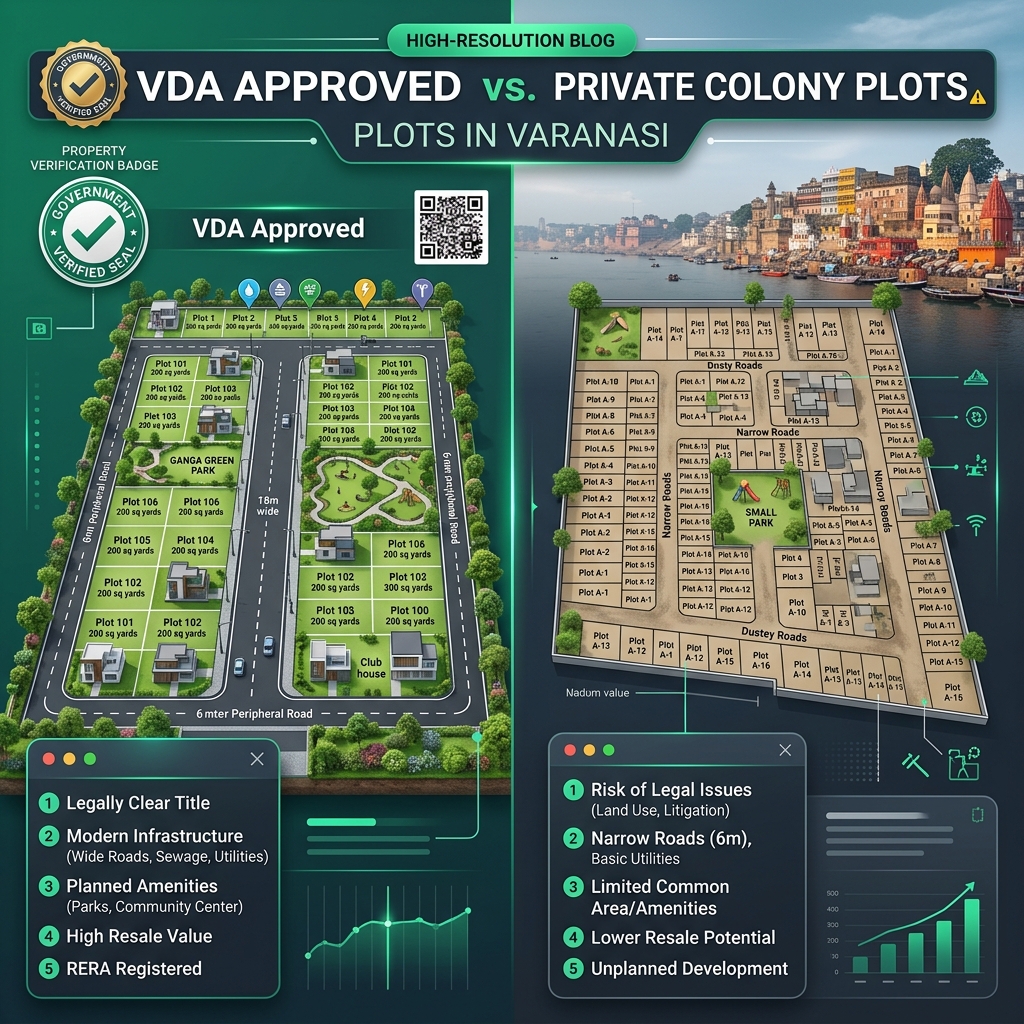
If you are planning to buy a residential plot in Varanasi, the single most important check you can do — before you even talk about price — is confirming whether the layout is approved by the Varanasi Development Authority (VDA) or is an unapproved (illegal) colony. Every year, thousands of buyers in Varanasi lose lakhs of rupees to fake layout plans, agricultural land sold as "residential plots," and colonies that get demolished years after possession.
This guide breaks down exactly what a VDA approved layout means, how unapproved colonies operate, and a step-by-step method to verify any plot before you pay a single rupee.
📜 Disclaimer
This article is for general informational purposes only and does not constitute legal advice. Property laws, VDA rules, and government portals can change; always verify current details on the official VDA website (vdavns.com) and consult a qualified property lawyer before making a purchase decision.
What is VDA and Why Does Its Approval Matter?
The Varanasi Development Authority (VDA) was established in 1974 and is responsible for planned urban development across Varanasi and the surrounding development region, which spans roughly 793 sq. km and includes hundreds of villages on both sides of the Ganga. VDA's job includes preparing the Master Plan, sanctioning building maps, and — most importantly for plot buyers — approving colony and plotting layouts before land can be legally subdivided and sold as residential plots.
When a layout is "VDA approved," it means:
- The land's ownership and land-use classification have been officially verified by the authority.
- The developer has submitted road, drainage, water supply, electricity, and open-space plans that meet VDA's infrastructure standards.
- Each plot is registered against a specific layout permit number, tied to the Gata/Arazi (survey) number of the land.
- Buyers can legally get building permission, bank home loans, and later resale value without a cloud on title.
An unapproved colony, by contrast, is one where land has been subdivided and plots sold without this sanction — often on land that is still classified as agricultural in revenue records.
VDA Approved Layout vs Unapproved Colony: Key Differences
| Feature | VDA Approved Layout | Unapproved Colony |
|---|---|---|
| Layout sanction | Has a valid VDA layout permit number (e.g., VDA/LO/23-24/XXXX) | No permit, or a fake/forged one |
| Land use | Residential, converted from agricultural via Section 143 if required | Often still agricultural in Khatauni records |
| Infrastructure | Roads, drains, water and electricity as per VDA norms | Often kutcha roads, no formal drainage or utilities |
| Bank loan | Usually eligible | Banks typically refuse or flag high risk |
| Building permission | Can be obtained from VDA | Difficult or impossible; risk of demolition |
| Resale value | Stable and legally clean | Depressed, buyers hard to find |
| Legal risk | Low, if title is otherwise clear | High — demolition, sealing, FIRs are common |
How to Check If a Layout Is VDA Approved: Step-by-Step
Check the Official VDA Approved/Non-Approved Colony List
VDA maintains a live, publicly accessible list of both approved and non-approved colonies on its official website (vdavns.com, under the "Colony" section). Before anything else:
- Search for the colony or project name in this list.
- Note that approval is specific to a layout permit number and the underlying Gata/Arazi number — not just the colony's marketing name. A developer can legally hold approval for one phase of a "colony" while selling plots in an unapproved adjoining section under the same brand name.
- Cross-check the layout permit number quoted by the seller against the number shown on the official list.
Verify the Land Classification on UP Bhulekh
Even inside the VDA development area, a plot can be shown to you as "residential" while its revenue record (Khatauni) still lists it as agricultural land. Pull the latest Khatauni from the UP Bhulekh portal and check the land-use category. If it is still agricultural, ask specifically whether a Section 143 conversion (under the UP Zamindari Abolition and Land Reforms Act, 1950) has been completed and mutated in the land records — this conversion is a mandatory legal step before residential construction, and it must happen before VDA layout approval can be issued.
Match the Layout Plan to the Actual Plot Number
Ask the seller for the sanctioned layout map (naksha) and confirm your specific plot number appears on it, along with its dimensions and road-facing direction. Fraudulent sellers sometimes show buyers a genuine-looking VDA approval letter for a different piece of land altogether.
Check RERA Registration for Plotted Projects
For organised plotted developments, verify the project's registration number on the UP-RERA website. A RERA-registered project is a strong signal that the layout has gone through proper legal channels, though RERA registration and VDA layout approval are two separate checks and both should be done.
Verify the Chain of Title and Encumbrance Certificate
Pull an Encumbrance Certificate (EC) covering at least the last 12–30 years from the sub-registrar's office or IGRS UP portal. This tells you whether the land has been sold multiple times to different buyers, is under litigation, or has any existing loan or mortgage against it.
Do a Physical Site Visit
Documents can be forged; roads, drains, and boundary pillars usually cannot be. Visit the site and check whether the roads, drainage, and other infrastructure shown in the layout plan actually exist on the ground. A wide gap between the "paper layout" and the physical site is a major red flag.
Buying a Plot in Varanasi? Get Official Layout Verification First
Advance payment karne se pehle specific colony ka VDA layout approval status, Gata/Arazi number, Section 143 conversion, and 30-year deed chain verify karwayein.
Red Flags That Suggest an Unapproved Colony
âš ï¸ Critical Red Flags to Watch Out For:
- The seller cannot produce a layout permit number, or is reluctant to share it in writing.
- The layout permit number does not match anything on the official VDA colony list.
- The Khatauni still shows the land as agricultural with no evidence of Section 143 conversion.
- Prices are noticeably below market rate for the area — often a sign the seller is compensating for legal risk.
- The colony has no formal roads, drainage, or electricity infrastructure on site.
- Multiple "layout plans" for the same land are circulating, or plot numbering doesn't match official records.
- The seller pressures you to register the sale deed quickly, before you can complete verification.
Real Consequences of Buying in an Unapproved Colony
🚨 Severe Demolition & Legal Risks
This is not a theoretical risk. VDA has actively demolished illegal plotted developments — including a large-scale demolition drive covering dozens of sites and well over 100 hectares of illegal plotting. There have also been cases where an FIR was registered against a builder after an approved residential building was later found to have unauthorized construction, resulting in electricity and water connections being cut off.
Once a colony is flagged as unapproved, buyers can face demolition notices, denial of building permission, inability to get a bank loan, and serious difficulty reselling the property — often years after they believed the purchase was complete.
A Quick Pre-Purchase Checklist
â˜‘ï¸ Mandatory Pre-Purchase Verification Checklist
- ✅ Colony/layout name checked against VDA's official approved/non-approved list
- ✅ Layout permit number verified and matched to the Gata/Arazi number
- ✅ Land-use classification confirmed on UP Bhulekh (residential, or Section 143 conversion completed and mutated)
- ✅ RERA registration checked for plotted projects
- ✅ Encumbrance Certificate pulled for the last 12–30 years
- ✅ Physical site visit done to confirm roads, drainage, and boundaries match the layout plan
- ✅ Sale deed and all documents reviewed by a property lawyer before registration
Frequently Asked Questions (FAQs)
Q1. Can an unapproved colony ever become legal later?
In some cases, state governments introduce regularisation or Layout Regulation Schemes that allow existing unapproved layouts to be regularised on payment of fees and penalties, but this is not guaranteed, is not automatic, and does not apply to purchases made after certain cutoff dates. Relying on future regularisation is a risk, not a safeguard.
Q2. Is a registered sale deed enough proof that a plot is legal?
No. A sale deed being registered at the sub-registrar's office confirms the transfer of ownership between buyer and seller; it does not by itself confirm that the underlying layout has VDA approval or that the land-use classification is residential. Both checks need to be done independently.
Q3. What is the single most reliable way to verify a plot in Varanasi?
There is no single check that covers everything. Combine the official VDA colony list, the Bhulekh land record, the Encumbrance Certificate, and a physical site visit — and where possible, have a local property lawyer review the full document chain before you pay any advance.
Q4. Does bank loan eligibility guarantee a layout is approved?
It's a strong positive signal, since banks generally avoid lending against unapproved layouts, but always verify independently rather than relying on the bank's due diligence alone.
Final Word
Buying land in a fast-growing city like Varanasi means the pressure to move quickly is real — but the cost of skipping verification is far higher than the time it takes to do it properly. Before you finalise any plot, check the VDA approved/non-approved colony list, confirm the land classification, verify the layout permit number, and get a lawyer to review your documents. A few days of due diligence can save you years of legal trouble.
For official lists, layout maps, and municipal guidelines, always refer to the official VDA portal: vdavns.com
Need Official Verification for Your Plot Layout?
Connect directly with PropertyPass Legal Team in Varanasi to verify VDA layout approval, Section 143 status, 30-year deed chain, and EC before paying advance.
Fast response within 30 mins • Official Legal Audit
Written by PropertyPass Legal Desk
Dedicated to making Varanasi real estate safer through rigorous verification and expert guidance. Our legal team works to ensure you invest in verified plots only.