How to Verify Property Documents in Varanasi (2026 Guide)
PropertyPass Verification Team
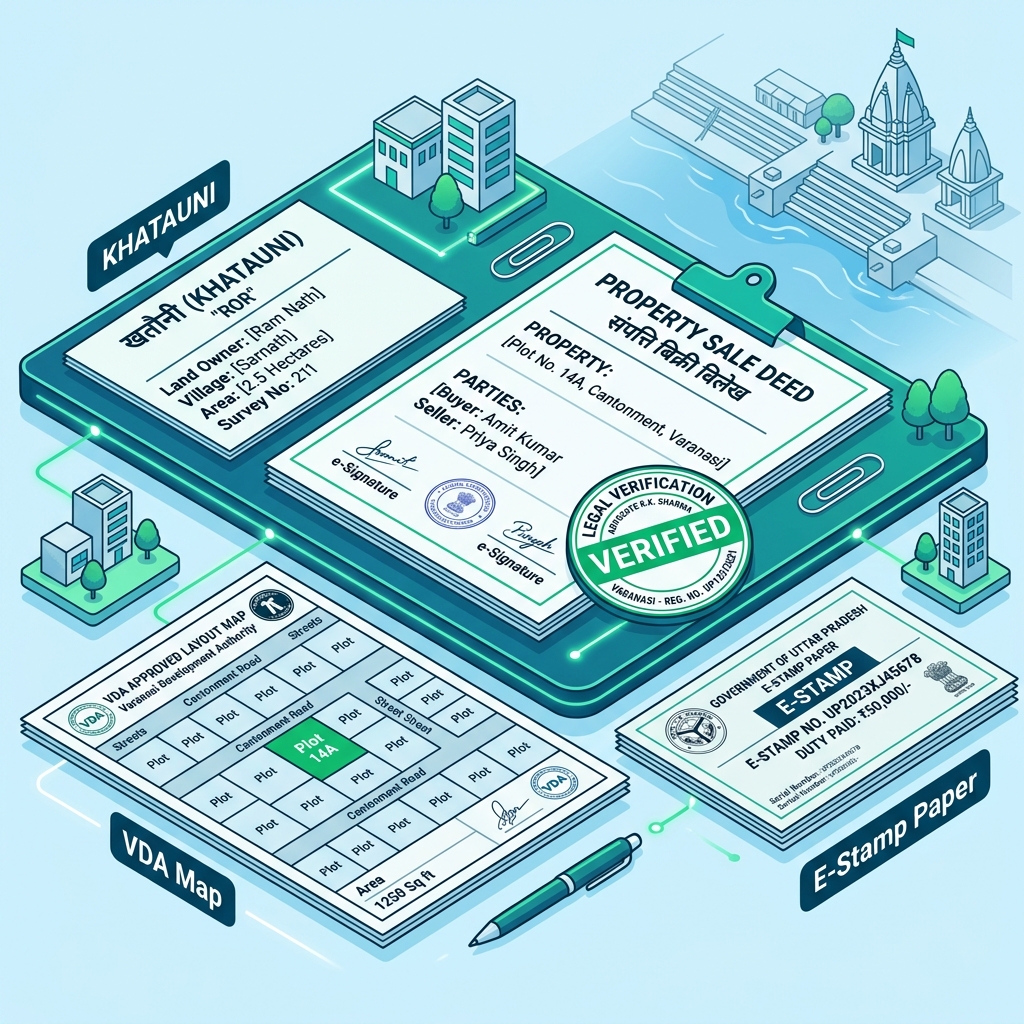
Buying a plot or property in Varanasi is one of the biggest financial decisions most families make — and it's also one of the easiest transactions to get defrauded in. Agricultural land quietly sold off as "residential," photocopied sale deeds with a genuine-looking stamp, layouts claiming VDA approval that don't actually exist on record — these aren't rare edge cases in Varanasi's fast-growing outer zones (Rohania, Chandmari, Harhua, Ramnagar, Babatpur). They're common enough that every serious buyer needs a fixed checklist, not just "trust but verify."
This guide walks through every document and government portal you need to check before you pay a single rupee of token money — in the order you should actually check them.
Quick-Glance Verification Checklist
Before diving into the detailed steps, here's the quick summary checklist — bookmark this section:
| # | What to Check | Where to Verify / Authority |
|---|---|---|
| 1 | Original Sale Deed / Title Deed | Physical document + Sub-Registrar Office (Sadar/Pindra) |
| 2 | Khatauni & Khasra (Ownership + Land Type) | upbhulekh.gov.in |
| 3 | Encumbrance Certificate (12–30 yr EC) | igrsup.gov.in |
| 4 | Bhu-Naksha (Cadastral Boundary Map) | upbhulekh.gov.in / Bhu-Naksha Portal |
| 5 | VDA Layout Approval Status | vdavns.com / VDA Office Hub |
| 6 | Land-Use Conversion (if ex-agricultural) | SDM Revenue Court Order / Khatauni Remarks (Sec 143/80) |
| 7 | UP RERA Registration (for projects/townships) | up-rera.in |
| 8 | Property Tax Dues Cleared | Varanasi Nagar Nigam / VDA Office |
| 9 | 12–30 Year Chain of Title | Sub-Registrar Archives (Bahi / Volume Search) |
| 10 | Aadhaar-Linked Registration Compliance | IGRSUP (Mandatory rule from Feb 2026) |
| 11 | Physical Site Visit & Demarcation | On-Ground Verification & Neighbor Survey |
Step 1: Start with the Original Sale Deed
Ask the seller for the original registered Sale Deed — not a photocopy, not a "true copy" attested by a notary. Check:
- The registration number, book number, and volume number stamped by the Sub-Registrar.
- That the seller's name on the deed matches their Aadhaar/PAN exactly.
- The property description (khasra number, area, boundaries) matches what's actually being sold.
If the seller can only produce an Agreement to Sell or a General Power of Attorney (GPA) instead of a registered Sale Deed, be cautious — GPA-based "sales" are a common route for disputed or agricultural land in Varanasi's outer areas, and courts have repeatedly held that a GPA alone doesn't transfer ownership.
Step 2: Verify Khatauni and Khasra on UP Bhulekh
Go to upbhulekh.gov.in, select Varanasi district, and pull up the Khatauni (record of rights) using the khasra/gata number written in the Sale Deed. Confirm:
- The current registered owner's name matches the person selling to you.
- The land classification — this is critical. If the Khatauni still shows the land as krishi (agricultural), you cannot legally build a residential structure on it without conversion (see Step 5), no matter what the broker tells you.
- There's no "vivadit" (disputed) flag or pending litigation remark against the plot.
- Mutation (dakhil-kharij) has actually been completed if the current owner bought or inherited it recently — an unmutated Khatauni means the record still shows the previous owner.
The portal also shows the Bhu-Naksha (site map) for the same plot — cross-check the boundaries and dimensions against the Sale Deed and the physical site.
Need Legal Experts to Verify Your Property Documents in Varanasi?
Don't risk buying a disputed or unapproved property. Our expert real estate lawyers in Varanasi verify Khasra-Khatauni records, 30-year sale deed chains, VDA map approvals, and EC certificates for 100% legal safety.
Step 3: Get an Encumbrance Certificate (EC) from IGRSUP
The EC, issued through igrsup.gov.in, tells you whether the property has any registered mortgage, loan, court attachment, or prior sale against it during the period you search.
- Ask for a 12-year EC at minimum; for higher-value plots, get a 30-year EC to trace the full ownership chain.
- Form 16 means "no encumbrance found" — clean record.
- Form 15 lists every transaction found — read it line by line; if a bank loan or mortgage shows up that hasn't been formally released, do not proceed until the seller produces a loan closure/release document.
- The digital EC carries a QR code and digital signature — banks and courts across UP accept it as legally valid, so there's no reason to skip this step even if the seller says "sab clear hai, trust karo".
Step 4: Check VDA Approval Status — Don't Rely on the Broker's Word
This is where most Varanasi-specific fraud happens. A layout being called "VDA approved" in a WhatsApp forward or a broker's brochure means nothing on its own. Verify independently:
- Visit vdavns.com and check our VDA Approved Properties Hub to verify official layout lists.
- Match the layout approval number on the seller's documents against this list — numbers alone don't prove anything if they don't appear in VDA's own records.
- If in doubt, a physical visit to the VDA office with the layout number is worth the half-day it takes — VDA sealed over a thousand illegal constructions across Varanasi last year, and buyers in those layouts had no legal protection.
If the plot falls under an unapproved private colony, you can still buy it, but go in with your eyes open: no guaranteed roads/drainage/electricity from VDA, higher risk of future demolition action, and banks are far more reluctant to approve home loans against it.
Step 5: If the Land Was Ever Agricultural, Check the Section 143 Conversion
Land bought as agricultural cannot be legally used for residential construction unless it has gone through land-use conversion under Section 143 of the UP Zamindari Abolition and Land Reforms Act (now Section 80 of the UP Revenue Code 2006) — an order passed by the Sub-Divisional Magistrate (SDM). Ask for this conversion order and confirm it's been reflected (mutated) in the Khatauni. Building without this conversion, even inside an otherwise "VDA-approved" area, puts your structure at risk of a demolition notice.
Step 6: Check UP RERA Registration for Any Organized Project
If you're buying inside a plotted development, colony scheme, or group housing project (not a standalone individually-owned plot), check its registration on the UP RERA website (up-rera.in). RERA registration means the developer has disclosed the project layout, timelines, and land title to the regulator — an extra layer of accountability that individual plot sales don't have.
Step 7: Confirm Property Tax is Paid Up to Date
Outstanding property tax dues to the Varanasi Municipal Corporation (Nagar Nigam) or VDA can become the new owner's liability after registration. Ask for the latest tax receipt and, where possible, confirm the "no dues" status directly with the local ward office before finalizing. Also check circle rates with our Varanasi Circle Rate Finder to budget registration taxes accurately.
Step 8: Trace the Ownership Chain, Not Just the Current Deed
A clean current Sale Deed doesn't rule out a defect three owners back. Have a lawyer (or your verification service) trace the chain of title for the last 12–30 years through the Sub-Registrar's archives — this catches issues like a previous sale that was never properly registered, an heir who was left out of an inheritance-based transfer, or duplicate sale deeds for the same plot (a known pattern in fast-appreciating peri-urban Varanasi).
Step 9: Know the New Aadhaar Authentication Rule (Feb 2026 UP Mandate)
From 1 February 2026, Aadhaar-based biometric authentication became mandatory for property registration across Uttar Pradesh — buyers, sellers, and witnesses must all complete biometric verification at the time of registration. This is a genuine anti-fraud upgrade: it makes impersonation and benami (proxy-name) transactions significantly harder to pull off. If a seller or their representative resists biometric verification or offers excuses for skipping it, treat that as a major red flag.
Step 10: Walk the Plot Yourself Before You Pay
No document check replaces a physical site visit. Confirm:
- The plot's actual boundaries match the Bhu-Naksha and Sale Deed dimensions — get it demarcated by local Lekhpal if there's any doubt.
- There's no one else occupying or cultivating the land.
- Access road, drainage, and utility lines match what was promised.
- Groundwater/soil conditions if you're planning immediate construction (in several Varanasi zones near the river and canals, borewells need to go significantly deeper for a reliable water supply). Explore localized checks for areas like Shivpur, Rohania, and Babatpur.
Common Frauds to Specifically Watch for in Varanasi
1. Agricultural Land Sold as "Residential Plots"
Selling land without Section 143/80 non-agricultural conversion order from the SDM, often in fast-growing outer zones (Rohania, Harhua, Babatpur).
2. Fake or Non-Existent VDA Layout Approvals
A stamp or number printed on a broker's brochure that doesn't match VDA's actual official record at vdavns.com.
3. GPA-Based "Sale" Instead of Registered Sale Deed
Selling property via un-registered General Power of Attorney, which courts have repeatedly ruled invalid for title transfer in UP.
4. Duplicate Sale Deeds for the Same Khasra Number
Selling the same khasra land parcel to two different buyers using unmutated older records.
5. Unmutated Inherited Property Sold by One Heir
Selling ancestral land without the consent or signature of other legal co-heirs listed in the family tree.
Frequently Asked Questions (FAQs)
How can I check if a plot is VDA approved in Varanasi?
Check the layout/colony name and approval number against the official approved-colonies list on vdavns.com, or visit the VDA office directly with the layout number. Don't rely on a broker's claim or a stamp alone.
What is an Encumbrance Certificate and why do I need it?
It's an official record from the Sub-Registrar (accessed via igrsup.gov.in) showing every mortgage, loan, or legal claim registered against a property over a chosen period. It's the single fastest way to confirm a plot is free of hidden financial liabilities.
Is Aadhaar mandatory for property registration in UP now?
Yes. Since 1 February 2026, biometric Aadhaar authentication is compulsory for buyers, sellers, and witnesses at the time of registration in Uttar Pradesh.
How do I check Khatauni online for a plot in Varanasi?
Visit upbhulekh.gov.in, select Varanasi district, and search using the khasra/gata number to view the current Khatauni, land classification, and any dispute flags.
Can I legally build a house on agricultural land in Varanasi?
Not without a Section 143 land-use conversion order from the SDM, mutated into the Khatauni. Skipping this step, even on an otherwise reputable-looking layout, risks a future demolition notice.
How much does full document verification typically cost?
Costs vary by scope (EC search period, lawyer fees, physical verification). PropertyPass offers a free first document check — see our verification tools before you commission a paid legal opinion.
Before You Pay Any Token Money
Use our free Property Document Checklist Tool to track each of the steps above against your specific plot, cross-check the layout against our VDA Approved Properties Hub, and get an instant estimate with the Circle Rate Finder. If you'd rather have this done for you, PropertyPass's first verification is free — we cross-check every document against IGRS UP, UP Bhulekh, and UP RERA before you commit.
Get Your Plot Checked by Varanasi's Top Legal Desk
Share your property details or document copies on WhatsApp. Our legal desk will audit Tehsil Bhulekh records, IGRSUP deed history, and VDA master plan zoning before you pay any token advance.
Fast response within 30 mins • Confidential & Official Audit
Written by PropertyPass Verification Team
Dedicated to making Varanasi real estate safer through rigorous verification and expert guidance. Our legal team works to ensure you invest in verified plots only.