How to Verify a Plot Before Buying in Varanasi: Complete Legal Checklist (2026)
PropertyPass Legal Desk
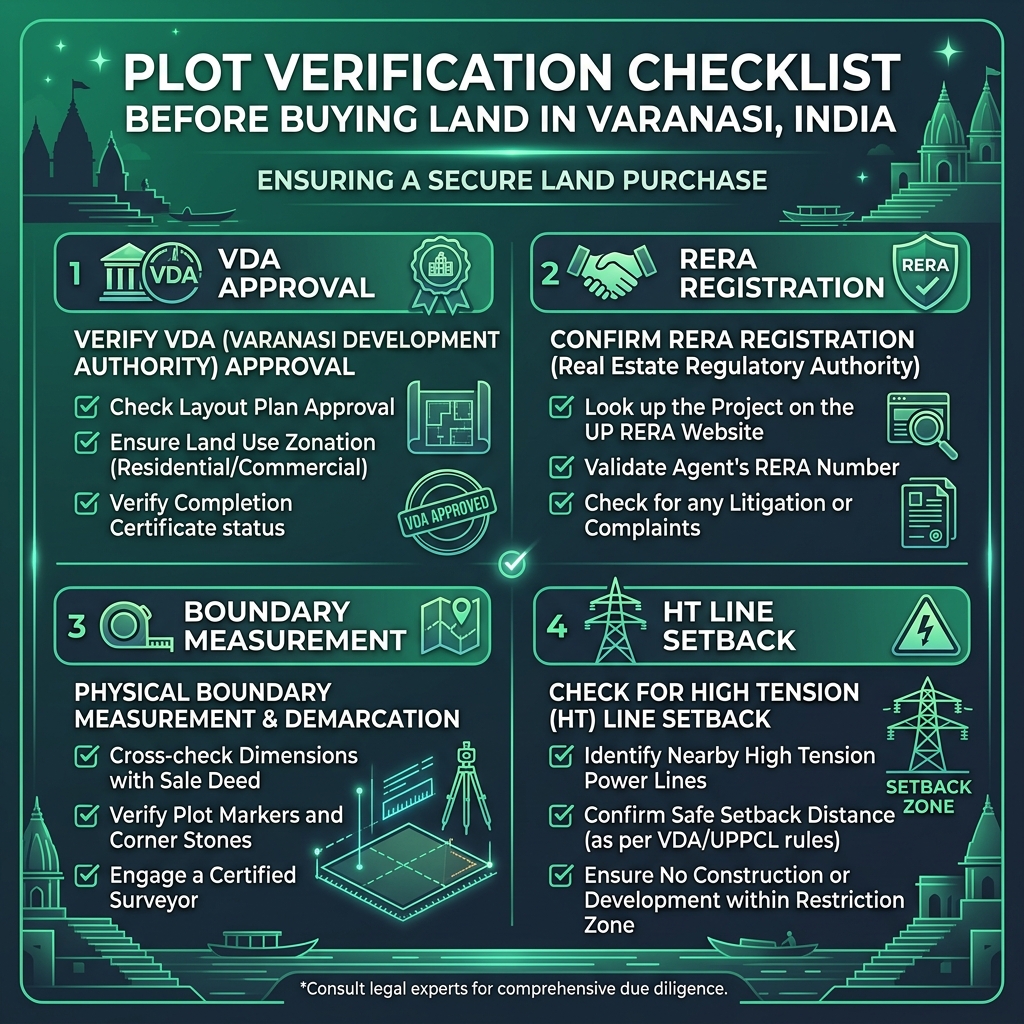
Varanasi's real estate market has been expanding fast. The Varanasi Development Authority's (VDA) master plan now covers the city and hundreds of surrounding villages stretching toward Ramnagar and the Chandauli border, and new "plotted colonies" keep appearing along the Ring Road, the airport corridor, and the roads leading out toward Sarnath. That growth is exactly why plot verification here deserves more care than a generic checklist.
Varanasi is one of the oldest continuously inhabited cities in the world, and its land records carry that history. A meaningful share of land in the older parts of the city is Nazul land — government property leased out for decades rather than sold outright. Ancestral plots are often still undivided among several legal heirs. And a lot of what's being marketed as a "residential plot" on the city's expanding edges is, on paper, still farmland that has never been through the formal conversion or layout-approval process.
None of this means you shouldn't buy land in Varanasi. It means you verify it properly, in the right order, before you hand over any money. This guide walks through exactly that — the records to pull, the portals to use, and the local quirks (Nazul status, Section 143 conversion, VDA approval, heritage buffer zones) that trip up buyers here specifically. It's written to help you ask the right questions and read the right documents. It isn't legal advice for your particular transaction — pair it with a local property lawyer before you sign anything.
âš¡ The Short Version (6 Things to Remember)
- Pull the Khatauni for the exact khasra number from the UP Bhulekh portal — don't rely on what the seller tells you it says.
- Check the land-use classification. If it's still recorded as agricultural, ask for the conversion order before treating it as a buildable residential plot.
- Confirm VDA approval for the specific plot, not just "the colony has houses in it already."
- Get an Encumbrance Certificate covering as long a period as the portal allows.
- Verify who's actually allowed to sell it — check for co-heirs, and never rely on a Power of Attorney alone.
- Only a registered sale deed transfers ownership. Everything else — token money, an agreement to sell, a GPA — is a promise, not a title.
The rest of this guide explains how to actually do each of these, plus the document list, red flags, and answers to the questions buyers ask most.
Why Varanasi Plots Need Extra Diligence
A few things make land verification in Varanasi different from, say, a plotted layout in a newer NCR suburb:
- Ancestral, undivided property A lot of land here has passed down through generations without formal partition. The person selling you the plot may be one of several legal heirs, and a sale that isn't signed by all of them (or backed by a proper release deed) can be challenged later.
- Nazul land Several pockets of the city sit on land technically owned by the state government and only leased to private occupants, sometimes for 15 to 99 years. This land can't simply be resold like freehold property, and state policy on regularising it has shifted more than once in the last few years.
- Farmland sold as "plots" As the city expands outward, agricultural land near the outskirts is frequently subdivided and marketed as residential plots before it has legally been converted or before any layout has VDA approval.
- Heritage and riverfront restrictions Land near Sarnath and the Ganga ghats can fall inside Archaeological Survey of India (ASI) buffer zones, which restrict construction independently of what VDA or the revenue department says.
- Overlapping local authorities Depending on exactly where the plot sits, it may fall under Varanasi Nagar Nigam, the separate Varanasi Cantonment Board, VDA's outer planning area, or — if it's on the Mughalsarai side — the neighbouring Chandauli district's revenue records altogether (Chandauli was carved out of Varanasi district in 1997).
With that context, here's the step-by-step process.
Step 1: Read the Sale Deed and Trace the Ownership Chain
Start with the current owner's sale deed (or the document by which they acquired the property — inheritance, gift, or purchase). Then trace backward: who owned it before them, and how did that transfer happen? Each link in the chain should be a properly registered document. Aim to trace ownership back at least 12–13 years, and ideally 30 years if the documents are available — this is also the period most banks and lawyers use for a standard title search. Watch for gaps, names that don't match across generations, or transfers that were never registered.
Step 2: Pull the Khatauni and Khasra from UP Bhulekh
Uttar Pradesh's land records are digitised on the Bhulekh UP portal (upbhulekh.gov.in). To check a plot:
- Go to the portal and select "Khatauni (अधिकार अà¤à¤¿à¤²à¥‡à¤–) की नकल देखें."
- Choose district Varanasi, then the correct tehsil — Varanasi district has three: Sadar, Pindra, and Rajatalab — then the village.
- Search by khasra (plot) number, khata number, or the owner's (khatedar's) name.
The record that comes up will show the recorded owner's name, the land's classification (agricultural/krishi versus abadi/residential), the area, and recent mutation entries. Two things to double-check: that the khatedar's name actually matches the person selling to you, and that you've selected the correct district. If the plot is on the Mughalsarai side (now Pandit Deen Dayal Upadhyaya Nagar), its Khatauni sits under Chandauli district, not Varanasi, even though the area falls within VDA's planning limits — searching under the wrong district will show no record at all, which some sellers use to claim (falsely) that the land is "clean."
A printed copy from the portal is useful for a first check, but a certified copy from the tehsil carries more weight for formal purposes.
Need Legal Experts to Verify Your Plot Documents in Varanasi?
Don't risk paying token money on disputed land. Our local legal team audits Bhulekh Khasra records, VDA layout approvals, 30-year deed chains, and Encumbrance Certificates to guarantee 100% legal safety.
Step 3: Find Out Whether It's Nazul Land
"Nazul" refers to land owned by the state government but historically leased out to individuals or institutions rather than sold outright, often for terms of 15 to 99 years. It's common across older Uttar Pradesh cities, including Varanasi, and it doesn't behave like freehold property — a leaseholder generally can't resell, subdivide, or change its use without the government's consent, and full "freeholding" has been the subject of shifting state policy for years. The Uttar Pradesh Nazul Properties (Management and Utilisation for Public Purposes) Bill, first introduced in 2024, has moved between the state assembly, the legislative council, and a select committee without being finalised — meaning the rules on converting Nazul leases into clean, freely transferable titles could still change.
If the Khatauni entry or the seller mentions Nazul, government, or "pattadari" land, treat it as a step that needs a specialist, not a standard purchase. Ask for the original lease deed, the most recent renewal order, and any written government permission for transfer, and get a lawyer to confirm the current status before paying anything.
Step 4: Confirm the Land-Use Classification (and Look for a Conversion Order)
Many plots on Varanasi's outer edges are still recorded as agricultural in the Khatauni, even when they're being actively marketed as residential plots. Converting agricultural land to residential, commercial, or industrial use is a formal process — historically done under Section 143 of the UP Zamindari Abolition and Land Reforms Act, 1950, and now technically handled under Section 80 of the UP Revenue Code, 2006 (which replaced Section 143, though "Section 143 conversion" is still the term everyone uses in practice). Either way, it works the same: a revenue official (the Lekhpal) surveys the land, the Tehsildar endorses the report, and the Sub-Divisional Magistrate issues a declaration converting the land's classification — which then needs to be reflected in the Khatauni before any building or layout approval is valid.
If a plot is marketed as a residential-ready site but its Khatauni still shows agricultural use with no conversion order on file, don't treat that as a minor paperwork gap — any construction on it risks future enforcement action, and it usually means no valid layout approval exists either (see the next step). Note also that land linked to SC/ST landholders or subject to ceiling-related restrictions can require additional District Magistrate permission before a change of use or sale, so ask specifically if that applies.
Step 5: Verify VDA's Layout Approval — for This Specific Plot
The Varanasi Development Authority (VDA), set up in 1974, governs planned development across the city and a large surrounding area under its Master Plan 2031, which zones land as residential, commercial, industrial, institutional, heritage/conservation, green, or agricultural. VDA also publishes lists of officially approved colonies and separately flags unauthorised ones (available on vdavns.com and on our VDA Approved Hub), which is worth checking before you assume "the colony already has houses in it" means it was ever sanctioned.
A few things buyers routinely miss here:
- Approval is plot-specific. A VDA layout sanction is tied to a particular gata/arazi (survey) number. It doesn't automatically extend to the neighbouring plot just because it's in the same area — match the survey number on the actual sanction letter to your plot's khasra number, not just the general locality.
- Heritage zones carry extra restrictions. Land near Sarnath or the Ganga ghats can fall inside an Archaeological Survey of India buffer around a protected monument. Under the Ancient Monuments and Archaeological Sites and Remains Act, 1958, construction is banned outright within 100 metres of a protected monument, and permission from the National Monuments Authority is required for construction in the next 200 metres beyond that (i.e., up to 300 metres from the monument). If a plot sits anywhere close to Sarnath or a protected ghat structure, verify the exact distance with the ASI and VDA — a local layout approval doesn't override this.
- Ramnagar and the Mughalsarai side follow separate plans. Both fall within VDA's broader jurisdiction but are governed by their own zonal plans rather than the core-city map, so don't assume rules that apply near the city centre automatically apply there.
- Approved-looking doesn't mean approved. VDA has, on more than one occasion, taken enforcement action — including demolitions and complaints against builders — over plotted developments and buildings that didn't match their sanctioned layout. An occupied-looking colony is not proof that it was ever approved. Check verified areas like Shivpur VDA plots or Babatpur VDA plots directly.
Step 6: Get an Encumbrance Certificate via IGRSUP
The Encumbrance Certificate (EC) is issued through the IGRSUP portal (igrsup.gov.in) — Uttar Pradesh's Integrated Grievance Redressal System for the Stamp and Registration Department. It lists every registered transaction against the property for a period you specify: prior sales, mortgages, gift deeds, partition deeds, and court attachments. Request the longest period the portal allows rather than the bare minimum a lender might ask for — a 12–13 year EC is common for loan purposes, but a 30-year search gives a fuller picture for an outright purchase.
One important limitation: an EC only reflects registered transactions. An unregistered family dispute or an informal claim that was never filed with the registrar won't show up here, which is why an EC should support, not replace, a lawyer's independent title search.
Step 7: Confirm Mutation (Dakhil-Kharij) Actually Happened
Registering a sale deed and updating the revenue record (mutation, or dakhil-kharij) are two separate steps — a seller can have a properly registered deed while the Khatauni still shows an earlier owner, sometimes a deceased parent whose name was never formally updated. Cross-check the current khatedar name on Bhulekh against the person who will actually sign as seller, and ask for the mutation order if there's any mismatch.
Step 8: Verify the Seller's Identity, Heirs, and Any Power of Attorney
Confirm the seller's identity through standard ID documents (Aadhaar, PAN). Then go further on two points that come up often in Varanasi specifically:
- Inheritance and co-heirs. If the property came through inheritance — which is common for older, undivided family land — check whether every legal heir has either signed the sale or executed a registered release deed in favour of the seller. A sale by only one of several heirs is a frequent source of later disputes.
- Power of Attorney. If someone other than the recorded owner is selling on the strength of a Power of Attorney, know the legal position: in Suraj Lamp & Industries Pvt. Ltd. v. State of Haryana (2011), the Supreme Court held that a General Power of Attorney — or a Sale Agreement + GPA + Will combination — does not by itself transfer ownership. Only a registered sale deed executed with the actual titleholder's authority does that. If a POA is involved, confirm it's registered, still valid (not revoked, and the grantor is still alive and hasn't since sold the property directly), and where possible get direct confirmation from the actual owner rather than relying solely on the attorney-holder's word.
Step 9: Rule Out Litigation and Government Acquisition
Bhulekh sometimes flags an active revenue dispute against a khasra number, but civil suits filed in the district courts or the Allahabad High Court won't necessarily show up there — a lawyer's litigation search covering both revenue and civil records is more reliable than the online portal alone. Separately, check with VDA or the relevant road authority whether the plot falls inside any proposed acquisition, road-widening, or expressway alignment — Varanasi has several active infrastructure projects in progress, and land under acquisition carries very different risk than an unencumbered plot, even if it looks fine on the ground today.
Step 10: If It's Part of a Builder's Project, Check UP RERA
If you're buying into a developer-marketed plotted colony or township rather than an individual's ancestral plot, check the project's registration on up-rera.in under "Registered Projects," searching by project or promoter name. UP RERA's rules were amended again in 2026 to let buyers file complaints even against projects that should have registered but didn't, so a project's absence from the list isn't necessarily the end of the story — but a registered, RERA-compliant project gives you materially more recourse if something goes wrong. This step doesn't apply if you're buying a single plot directly from its individual owner.
Step 11: Clear Property Tax and Local Dues
Ask for the latest property tax receipt and confirm there are no pending dues, since arrears typically transfer with the property. Check through Varanasi Nagar Nigam's portal (nnvns.org.in) for plots within the municipal corporation area, or the separate Varanasi Cantonment Board portal if the plot falls within cantonment limits — these are two different authorities with two different systems.
Step 12: Physical Site Visit, Boundary Survey, and Final Legal Sign-Off
Visit the site in person — ideally more than once, including after rain, given that some low-lying pockets near the river are prone to waterlogging. Bring a licensed surveyor or Amin to match the physical boundaries against the Bhu-Naksha (cadastral map) available through Bhulekh, and confirm the access road is a genuine public right-of-way rather than a private path a neighbour could block later. Talk to people living nearby; local knowledge of disputes travels faster than paperwork does.
Finally, have a property lawyer prepare a written title-search report and either draft or vet the sale deed. Registration happens at the Sub-Registrar office for the tehsil where the property sits (Sadar, Pindra, or Rajatalab), and this — not the sale agreement, not the token payment, not a POA — is the step that actually transfers legal title.
Stamp Duty and Registration Charges in Varanasi
Stamp duty and registration follow Uttar Pradesh's statewide rates, calculated on whichever is higher: the agreement value or the government-notified circle rate for that locality (set by the District Magistrate and checkable on our Stamp Duty Calculator and Circle Rate Finder or the IGRSUP calculator).
| Buyer category | Stamp duty | Registration fee |
|---|---|---|
| Male buyer (sole ownership) | 7% of property value | 1% |
| Female buyer (sole ownership) | 6% of property value | 1% |
| Joint ownership (male + female) | 6.5% of property value | 1% |
| Gift/transfer between blood relatives | Flat ₹5,000 + ₹1,000 processing | Capped separately |
Uttar Pradesh has also periodically offered women buyers an additional rebate on properties below a certain value — the exact threshold and rebate amount have changed more than once, so confirm the current figure on the IGRSUP calculator or with the Sub-Registrar before budgeting around it.
Quick Document Checklist
| # | Required Document | Authority / Source |
|---|---|---|
| 1 | Original sale deed(s) in ownership chain | Sub-Registrar (12–30 years) |
| 2 | Certified Khatauni/Khasra copy | upbhulekh.gov.in / Tehsil |
| 3 | Encumbrance Certificate (EC Form 15/16) | igrsup.gov.in |
| 4 | Mutation (dakhil-kharij) order | Tehsildar Court / Revenue Record |
| 5 | Land-use conversion order (Sec 143/80) | SDM Order (if ex-agricultural) |
| 6 | VDA-approved layout sanction letter | vdavns.com / VDA Hub |
| 7 | UP RERA registration certificate | up-rera.in (for projects) |
| 8 | Latest property tax receipt | Varanasi Nagar Nigam / Cantonment Board |
| 9 | Seller's ID/PAN & Legal Heirs' Consent | Seller / Registered Release Deeds |
| 10 | Registered Power of Attorney (if used) | Sub-Registrar with Owner Confirmation |
| 11 | Lawyer's title-search & no-litigation report | Independent Legal Counsel |
| 12 | Site visit & boundary survey map | Bhu-Naksha + Licensed Surveyor / Amin |
Red Flags Worth Pausing On
🚨 Unrealistic Below-Circle Rate Pricing
Price noticeably below the area's circle rate, paired with pressure to close quickly or in cash.
📄 Missing Original Documents
Seller can produce only photocopies or notary printouts, not original registered deeds.
âš ï¸ GPA / Agreement-to-Sell Only Deal
The deal is structured only as a Power of Attorney plus an Agreement to Sell, with no registered sale deed offered.
🌾 Unconverted Farmland Sold as "Residential"
Khatauni still shows agricultural (krishi) land with no Section 143/80 conversion order, despite the plot being sold as a buildable site.
⌠Unapproved VDA Colony
The colony or gata number does not appear on VDA's official approved layout list at vdavns.com.
👥 Multiple Co-Heirs Without Release Deeds
Several family members have a legal claim on undivided ancestral land, but not all are signing the sale deed.
ðŸ›ï¸ Nazul Land Without Transfer Clearance
Land described as Nazul or government leasehold without a current valid lease deed and written state permission for transfer.
📠Boundary Mismatch with Bhu-Naksha
On-ground physical boundaries don't match the Bhu-Naksha cadastral map, or a neighbour disputes the boundary line during site inspection.
🛑 Resistance to Legal Opinion
Seller or broker shows reluctance to let you commission an independent Encumbrance Certificate or lawyer's title opinion before paying token money.
How Long This Takes, and What It Costs
Most of the online checks — Bhulekh, the IGRSUP encumbrance application, VDA's colony list, and a UP RERA search — can be done in a single sitting once you have the khasra number, though a certified copy or a processed EC application can take anywhere from a few days to a couple of weeks depending on the tehsil or registrar's workload. Government fees for these individual checks are nominal. The two costs worth actually budgeting for are the stamp duty and registration fee (a fixed percentage of the property's value, set out above) and your lawyer's and surveyor's professional fees for the title search and site verification — on a purchase this size, that's not the place to cut corners.
Frequently Asked Questions
Is it safe to buy Nazul land in Varanasi?
It can be bought, but it needs specialist handling. Nazul land is leasehold government property, and converting it to a freely transferable freehold title depends on state policy that has changed more than once in recent years and remains under legislative review. Get a lawyer to confirm the current lease terms and transfer permissions before paying anything.
What is "Section 143," and why does it matter for a plot in Varanasi?
It's the process (historically under Section 143 of the UP Zamindari Abolition and Land Reforms Act, 1950, now technically under Section 80 of the UP Revenue Code, 2006) by which the Sub-Divisional Magistrate formally converts land from agricultural to residential, commercial, or industrial use. Without this conversion reflected in the Khatauni, land legally remains agricultural even if it's being sold and marketed as a residential plot.
Can I safely buy a plot from someone holding Power of Attorney for the owner?
Not on the strength of the POA alone. The Supreme Court's ruling in Suraj Lamp & Industries v. State of Haryana (2011) confirmed that a General Power of Attorney doesn't transfer ownership — only a registered sale deed does. Confirm the POA is registered and still valid, and get direct confirmation from the actual owner where possible.
How do I check if a colony in Varanasi is VDA-approved?
VDA publishes lists of approved and unauthorised colonies (via vdavns.com). Even then, check that the specific gata/arazi number on the layout sanction matches your plot — approval doesn't automatically cover neighbouring survey numbers in the same general area.
How many years should an Encumbrance Certificate cover?
A 12–13 year EC is the common minimum for loan purposes, but requesting a 30-year EC gives a more complete picture for an outright purchase, since it's more likely to surface older mortgages, partitions, or attachments.
The Khatauni shows the land as agricultural — can I still buy it to build a house?
You can, but only if you get the Section 143/Section 80 conversion order and VDA layout approval in place before or as a binding condition of the sale. Building on unconverted agricultural land without those approvals risks future enforcement action.
Do I need to check RERA if I'm buying a single plot from an individual owner?
No — RERA registration applies to developer or promoter-led real estate projects, not to an individual selling their own ancestral or personally-owned plot. It becomes relevant if you're buying inside a marketed plotted township or colony run by a developer.
What's the difference between the Khatauni and the Encumbrance Certificate?
The Khatauni is the revenue department's record of who currently holds recorded rights to the land and how it's classified (agricultural or otherwise). The Encumbrance Certificate is the registration department's separate record of registered transactions — sales, mortgages, gift and partition deeds — against the property over a chosen period. You need both; neither one alone gives the full picture.
Final Word
Verifying a plot in Varanasi really comes down to checking four separate things that all have to line up: what the revenue record says (Bhulekh), what the planning authority permits (VDA), what the registrar's records confirm is unencumbered (IGRSUP), and what you can actually see and measure on the ground. Skipping any one of these — trusting "it's been in the family for years" or "it'll get regularised eventually" without paperwork to back it up — is the pattern behind most of the plot disputes buyers run into here. Take the time, or the professional help, to check all four before you sign anything.
Get Your Varanasi Plot Checked by Our Legal Desk
Share your khasra details or document copies on WhatsApp. PropertyPass Legal Desk will audit Tehsil Bhulekh records, IGRSUP deed history, and VDA master plan zoning before you pay any token advance.
Fast response within 30 mins • Confidential & Official Audit
Written by PropertyPass Legal Desk
Dedicated to making Varanasi real estate safer through rigorous verification and expert guidance. Our legal team works to ensure you invest in verified plots only.