How to Check Land Ownership in Varanasi: Complete Guide (2026)
PropertyPass Legal Desk
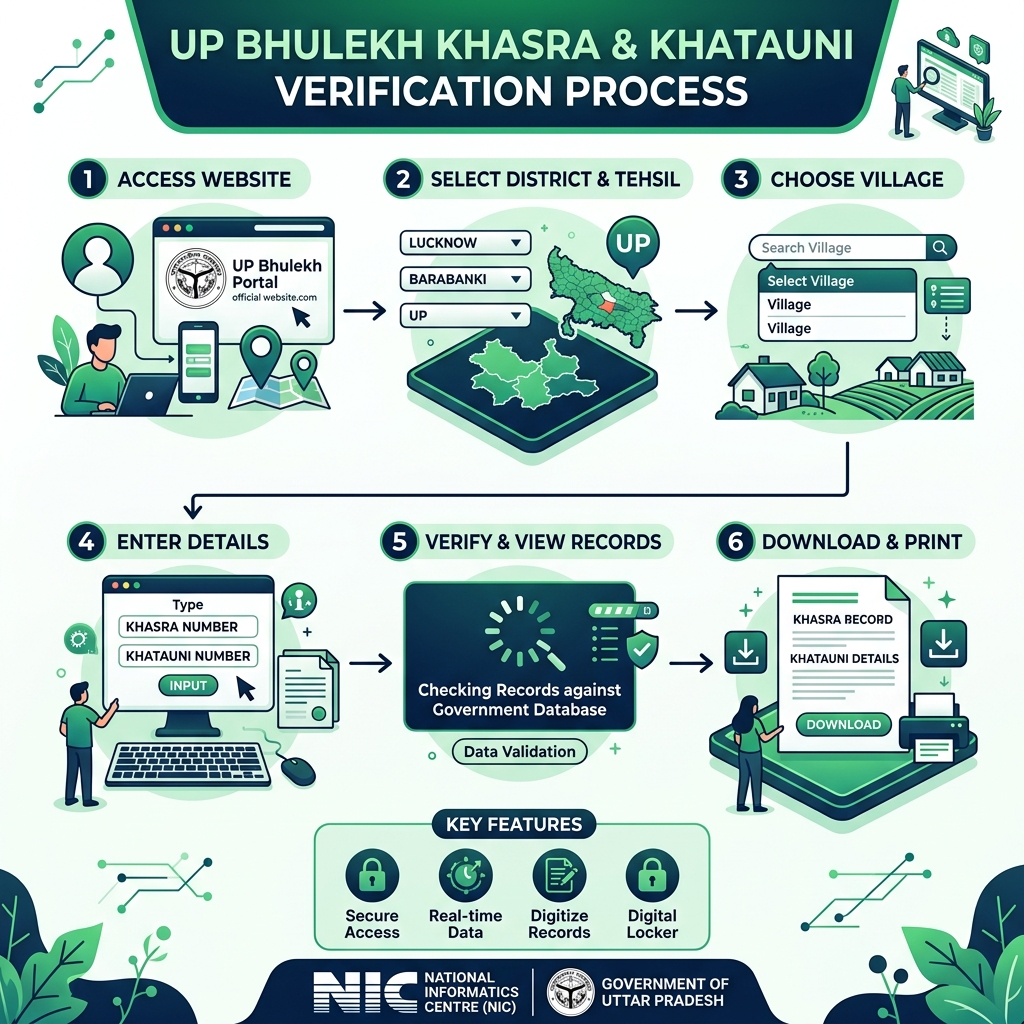
Buying land in Varanasi — or making sure your own family's land is correctly recorded — starts with one question: whose name is actually on the government record? In Uttar Pradesh, that answer lives across four different departments, not one, and Varanasi has a few local quirks (old-city leasehold land, a fast-expanding development authority, agricultural plots being sold as "residential") that trip up buyers who only check the obvious portal.
This guide walks through every official way to verify land ownership in Varanasi, online and offline, in the order you should actually do them.
âš¡ Quick Answer Checklist
- 1. Look up the Khatauni (ownership record) on UP Bhulekh (upbhulekh.gov.in) using district, tehsil, village and khasra/khata number.
- 2. Cross-check the plot's shape and boundaries on Bhu Naksha UP (upbhunaksha.gov.in).
- 3. Verify the registered sale deed and pull an Encumbrance Certificate on IGRS UP (igrsup.gov.in).
- 4. If inside city limits, check Varanasi Nagar Nigam property tax records (nnvns.org.in) and the VDA (vdavns.com) master-plan zone & approved-colony list.
- 5. For anything above a small value, get a certified copy from the Tehsil/Sub-Registrar office and have a property lawyer run a title search before paying anything.
Everything below explains each of these in detail, plus the documents to collect and the warning signs that mean you should walk away.
The Four Record Systems Behind Every Varanasi Property
Most guides send you straight to one portal. The reason people still get caught out is that no single UP portal tells the whole story — each one only answers part of the question:
| System | What it tells you | Who maintains it |
|---|---|---|
| Revenue records (Bhulekh) | Who the land is recorded to, plot size, land type (agricultural/other) | UP Revenue Department, via the Lekhpal/Patwari and Tehsildar |
| Registration records (IGRS) | Whether a sale deed was actually registered, and what else is registered against the plot (mortgages, prior sales) | Stamp & Registration Department |
| Municipal records (Nagar Nigam) | Who is paying property/house tax on a built-up urban property | Varanasi Nagar Nigam |
| Planning records (VDA) | Whether the land use is legally residential/commercial, and whether the colony or layout is approved | Varanasi Development Authority |
A property can look clean on one of these and still have a problem on another — for example, a Khatauni showing clear agricultural ownership, on land a broker is marketing as a "residential plot" with no VDA layout approval behind it. Treat the four systems as a checklist, not alternatives.
Quick Reference Table of Every Varanasi Property Portal
| Portal | Purpose | Website |
|---|---|---|
| UP Bhulekh | Khasra, Khatauni, ownership records | upbhulekh.gov.in |
| Bhu Naksha UP | Plot boundary map | upbhunaksha.gov.in |
| IGRS UP | Deed search, Encumbrance Certificate, stamp duty | igrsup.gov.in |
| UP RERA | Builder/project registration status | up-rera.in |
| Varanasi Nagar Nigam | Property/house tax records | nnvns.org.in |
| VDA | Master plan, approved colonies, layout plans | vdavns.com |
Step 1: Check the Khatauni on UP Bhulekh
The Khatauni (also called the Record of Rights) is the core ownership document for any plot in Uttar Pradesh. It names the recorded owner(s), the khasra/gata number, the area, the land classification, and any revenue-department remarks against the plot.
- Go to upbhulekh.gov.in.
- On the homepage, click "खतौनी (अधिकार अà¤à¤¿à¤²à¥‡à¤–) की नकल देखें" — Khatauni ki Nakal Dekhein (View Copy of Khatauni/Record of Rights).
- Complete the captcha to proceed.
- Select District: Varanasi, then the correct Tehsil (Sadar, Pindra, or Rajatalab), then the Village.
- Search using whichever detail you have: Khasra/Gata number, Khata number, or the Khatedar's (owner's) name.
- The record will display the current recorded owner(s), area, and land type. You can view, download or print it.
What to look for: does the name on the Khatauni match the name of the person selling you the land, or the name you expect on your own family's record? If the record still shows a deceased relative or a previous owner, mutation was never completed — see the documents section below on why that matters.
One important limit: a Khatauni printed from the website is meant for preliminary verification and due diligence, not as a certified legal document. If you need a certified copy for a court case, a loan application, or a formal dispute, you'll still need to apply for one through the Tehsil/Lekhpal or the certified-copy option on the portal.
Step 2: Confirm the Plot's Boundaries on Bhu Naksha
The Khatauni tells you who owns a plot; Bhu Naksha UP (upbhunaksha.gov.in) tells you where it is and what shape it is — this is the cadastral map layer, run separately from Bhulekh.
- Go to upbhunaksha.gov.in and select District (Varanasi), Tehsil and Village.
- Either click the plot directly on the visual map or type in the plot/gata number.
- Click Map Report to see the boundary, neighbouring plots, and exact measurements.
- Download the Plot Report PDF for your records.
This step matters more than people expect in Varanasi, where informal sub-division of ancestral agricultural land is common. A seller can show you a Khatauni for a khasra number while the physical plot they're pointing to on the ground is a different shape or size. Bhu Naksha is how you catch that mismatch before you pay a token amount.
Need Lawyers to Check Land Ownership Records in Varanasi?
Don't rely on unverified claims. Our expert property lawyers in Varanasi cross-check Tehsil Khatauni, Bhu Naksha boundaries, 30-year IGRSUP sale deeds, and VDA master-plan zoning so you buy with 100% legal clarity.
Step 3: Verify the Registered Deed and Pull an Encumbrance Certificate on IGRS UP
Ownership on the revenue side (Bhulekh) is one thing; whether the sale that created that ownership was properly registered is a separate check, done on IGRS UP (igrsup.gov.in) — the Integrated Grievance Redressal System run by the Stamp and Registration Department.
- Visit igrsup.gov.in and open "समà¥à¤ªà¤¤à¥à¤¤à¤¿ विवरण खोजें" (Search Property Details) under the property search section.
- Choose the district (Varanasi) and the relevant Sub-Registrar Office (SRO), then search by registration/document number, registration year, or the parties' names.
- To check the registration status of a specific deed, use the document-number search — this confirms the deed was genuinely registered and wasn't fabricated.
- To apply for an Encumbrance Certificate (EC) — the record of every mortgage, charge, or prior sale registered against the plot over a chosen period — use the EC option and enter the property's location details.
- IGRS UP also has a stamp duty and registration fee calculator, useful once you're ready to move ahead with a purchase (or check our guide on Registry & Stamp Duty Costs in Varanasi).
The EC is arguably the single most important document in this whole process: if someone claims clear ownership but the EC shows an outstanding mortgage or a second registered sale of the same plot, that's your answer. Note that an EC only covers registered transactions — unregistered agreements or informal transfers won't show up, which is another reason not to rely on IGRS alone.
Step 4: When You Need to Go in Person — Tehsil and Sub-Registrar Offices
Online portals are for verification and due diligence; certified copies for legal use, and any correction to a record, still require an in-person visit. Varanasi district has three tehsils, each with its own Tehsildar and Sub-Divisional Magistrate:
- Sadar — covers Varanasi city and the core urban area (Shivpur, Sigra, Sarnath, Paharia, Cantt).
- Pindra — the northwestern part of the district, around 24 km from the city (Babatpur Airport corridor).
- Rajatalab — the southwestern part of the district (GT Road, Rohania corridor).
For land under a given tehsil, the local Lekhpal (village-level revenue official) and Tehsildar are who you'd approach for a certified Khatauni copy, to report a mutation that hasn't gone through, or to raise a dispute. For registered documents, the relevant Sub-Registrar Office (SRO) — there are multiple SROs across the district, matched to specific tehsils/areas — issues certified copies of sale deeds and other registered instruments, and can confirm registration details in person if the online search doesn't resolve your query.
If you're unsure which tehsil or SRO covers a specific plot, the Varanasi district administration's official site (varanasi.nic.in) lists current contact details for the Collectorate and each tehsil office.
Step 5: Buying Inside City Limits? Check Nagar Nigam and VDA Too
If the property sits within Varanasi's urban/municipal area rather than being purely agricultural land in a rural revenue village, two more checks apply:
1. Varanasi Nagar Nigam (Municipal Corporation)
Property or "house" tax records show who is currently paying tax on a built-up property — a useful independent cross-check against the seller's claimed ownership. Visit nnvns.org.in (or propertytax.nnvns.org.in) and search using the House Number or Unique Property ID. If the name on the tax record doesn't match the seller, ask why before proceeding.
2. Varanasi Development Authority (VDA)
Established in 1974, VDA governs planned development for Varanasi city plus a wide surrounding belt of villages. Before buying a plot marketed as "residential" or inside a "colony," check on vdavns.com or our VDA Approved Hub:
- Master Plan / land-use map — confirms whether the plot is actually zoned residential, agricultural, or commercial.
- Approved vs unapproved colony lists — buying in an unapproved colony carries real risk: no guaranteed roads/drainage, and no legal layout protection.
- Layout approvals for private colonies and group housing to confirm advertised plans are genuine.
If land shown as agricultural in the Khatauni is being sold for construction, it legally needs a conversion order (commonly referred to as a Section 143 / Section 80 conversion under UP land revenue laws) from the Sub-Divisional Magistrate before VDA will approve any building layout on it, and that order needs to be reflected in the mutated land record. A plot without this is not construction-ready — regardless of what a broker tells you.
âš ï¸ Special Alert: Nazul (Leasehold) Land in Old Varanasi
This is the one issue most generic "how to check land records" articles skip, and it matters immensely in Varanasi specifically. Large parts of the old city — areas near the ghats, Godowlia, Chowk, and older residential lanes — sit on Nazul land: land that legally belongs to the state government and was historically leased out, rather than sold outright, to occupants or builders.
- • Nazul land is not automatically freehold: Even if a family has lived on a nazul plot for generations, the underlying title may still be a government lease, affecting your legal right to sell or mortgage it freely.
- • Freehold conversion is currently blocked: Following a March 2024 Uttar Pradesh government ordinance, nazul land can no longer be converted from leasehold to freehold in favour of private individuals or entities. Legislative updates continue, but as of 2026: do NOT assume a nazul plot can be converted to full private ownership.
- • How to check: Look at the land classification/remarks column on the Khatauni, and confirm lease status directly with the Tehsil Nazul Section.
Rule of thumb: If a deal depends on a nazul plot being "converted to freehold soon," treat that as a major red flag until verified by a property lawyer.
Documents You Should Collect and Cross-Check
Beyond online portal searches, ask the seller (or gather, if verifying family property) for these physical documents:
- Registered sale deed (and mother deed — the earliest document establishing original ownership — plus all link deeds in between).
- Current Khatauni / mutation extract showing the seller's name as the recorded owner.
- Encumbrance Certificate (EC) covering a 12–30 year period.
- Nagar Nigam Property tax receipts showing dues are cleared.
- Land-use conversion order (Section 143/80), if agricultural land is sold for residential building.
- Identity & Authority documents — Aadhaar/PAN of seller, plus registered Power of Attorney if an agent is executing the deal.
- NOC from society, bank, or development authority if ever mortgaged.
A useful rule: if the seller can't produce the mother deed or explain a gap in the ownership chain, that gap doesn't disappear just because everything else looks fine — it needs to be resolved before paying any material amount. Explore our comprehensive Property Document Verification Guide & Checklist.
Buying a Flat or Plot From a Builder? Check UP RERA Too
If you're buying into a group housing project, apartment scheme, or township marketed by a builder, check UP RERA (up-rera.in). Any residential or commercial project over 500 sq metres or with more than 8 units is legally required to register. Search by project name, promoter name, or RERA registration number to view approved layouts, promised possession dates, and registered buyer complaints. If a builder project doesn't appear on RERA, treat that as a dealbreaker. (Read more in our UP RERA Verification Guide for Varanasi).
Red Flags That Should Make You Pause
Quick Recap: Your Verification Checklist
- ✓ Khatauni checked on UP Bhulekh — owner name matches
- ✓ Plot boundary and area confirmed on Bhu Naksha
- ✓ Sale deed registration verified and Encumbrance Certificate pulled on IGRS UP
- ✓ Land-use / nazul status confirmed (agricultural vs. residential; leasehold vs. freehold)
- ✓ Nagar Nigam property tax record checked, if urban property
- ✓ VDA master plan zone and colony-approval status checked, if inside VDA's area
- ✓ RERA registration checked, if buying from a builder
- ✓ Mother deed, link deeds, and 12–30 year EC reviewed by a property lawyer
- ✓ Certified copies obtained from Tehsil/SRO for anything you plan to rely on legally
Frequently Asked Questions (FAQs)
Is the Khatauni copy downloaded from UP Bhulekh legally valid proof of ownership?
It's genuine government data and is reliable for preliminary verification and due diligence, but it isn't treated as a certified legal document. For a loan application, court matter, or formal dispute, get a certified copy through the Tehsil or the certified-copy process instead of using the downloaded printout.
Is there a fee to check khasra or khatauni details online?
Viewing and downloading the Khatauni on UP Bhulekh is free. Fees apply for certified copies obtained offline and for services like Encumbrance Certificates on IGRS UP — check the current fee shown on the portal at the time you apply, since government fee schedules change periodically.
How do I find out if a plot in old Varanasi is nazul or freehold?
Check the land classification and remarks on the Khatauni, and confirm directly with the Nazul section at the Tehsil/district administration. Don't rely on a verbal assurance from the seller or broker — this is exactly the kind of detail worth a lawyer's time before you commit.
What does it mean if the Khatauni still shows a deceased relative's or previous owner's name?
It means mutation was never completed after the last transfer or inheritance. The land may still be legally theirs to sell in practice (through the heirs), but you'll want the mutation resolved — or at minimum clearly explained and documented — before or as part of the transaction.
Can I check Varanasi land records from outside India?
Yes — Bhulekh, Bhu Naksha, IGRS UP, VDA and Nagar Nigam are all standard websites accessible from anywhere. Certified copies and in-person verification, however, will need someone with power of attorney or a local lawyer acting on your behalf in Varanasi.
What's the practical difference between Bhulekh, Bhu Naksha, and IGRS UP?
Bhulekh tells you who the revenue department has recorded as the owner. Bhu Naksha shows you the plot's physical shape, size and location on a map. IGRS UP tells you whether a sale was actually registered and what else — mortgages, prior sales — is registered against the property. You need all three; none of them substitutes for the others.
Who do I contact if an online record looks wrong?
For Bhulekh/Khatauni errors, raise it with the local Lekhpal or Tehsildar. For IGRS/registration issues, use the grievance section on igrsup.gov.in or contact the relevant Sub-Registrar Office. For VDA zoning or colony-approval queries, VDA's helpdesk (contact details are on vdavns.com) can clarify.
A Final Note
Government portal names, fee schedules, and exact procedures in Uttar Pradesh do get updated from time to time, and Nazul land policy in particular has been an active, evolving legal area since 2024 — so treat this guide as a map of where to look and what questions to ask, and confirm current fees and forms directly on the official portals when you're ready to act. For any transaction above modest value, the cost of a property lawyer running a full title search is small compared to the cost of an ownership dispute later. This article is written to inform, not as legal advice.
Get Land Ownership Verified by Varanasi's Legal Desk
Share your property details or Khasra/Khatauni copy on WhatsApp. Our legal team will audit UP Bhulekh revenue records, Bhu Naksha maps, Sub-Registrar IGRSUP deeds, and VDA master plan zoning before you pay any token advance.
Fast response within 30 mins • Confidential & Official Audit
Written by PropertyPass Legal Desk
Dedicated to making Varanasi real estate safer through rigorous verification and expert guidance. Our legal team works to ensure you invest in verified plots only.