Building a House on Agricultural Land Without VDA Approval in Varanasi: Penalties, Risks & Legal Solutions
PropertyPass Legal Desk
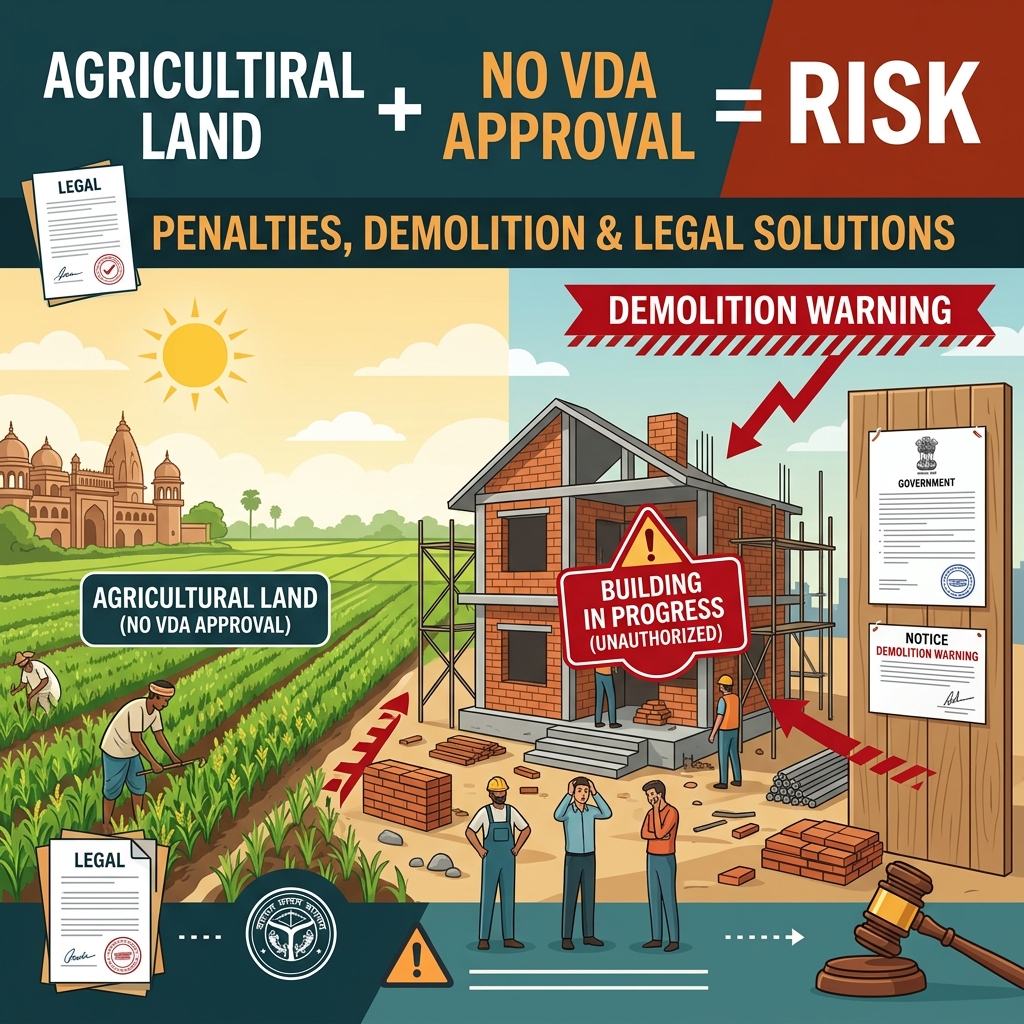
Varanasi is growing fast. Land prices around Sarnath, Ramnagar, Lanka, Sultanpur Road, Mirzamurad, Ring Road, and the Babatpur corridor keep rising. Many buyers find plots that look cheap, and many of those plots are classified as agricultural land.
Buying a plot and building on it without checking its land use is one of the most expensive mistakes a homebuyer can make. If you build on agricultural land without approval from the Varanasi Development Authority (VDA), you can face notices, sealing, fines, or even demolition.
This guide explains what happens, why, and what you can do about it.
âš ï¸ Disclaimer
This blog is for general information only. Laws, bye-laws, and VDA procedures change. Consult a qualified property lawyer and verify details with VDA before making decisions.âš¡ Key Takeaways
- Building on agricultural land without VDA approval is illegal and can lead to demolition, sealing, and fines.
- You need two separate permissions: land use conversion (Tehsil/SDM) + VDA building map approval.
- Consequences include: VDA notice → stop-work → sealing → demolition order → penalty/prosecution.
- Some violations can be regularised through compounding (Section 32) if bylaws allow.
- Banks will not finance and buyers will not purchase unapproved construction.
- Always verify khatauni, Master Plan zone, and land use status before buying any plot.
Why VDA Approval Matters
VDA is the planning and development authority for Varanasi. Under the Uttar Pradesh Urban Planning and Development Act, 1973, no person may carry out development or construction within a development area without prior permission from the authority.
VDA approval ensures that:
- The land use matches the Varanasi Master Plan (residential, commercial, green belt, agricultural, etc.).
- The building follows rules on setbacks, height, FAR (floor area ratio), and ground coverage.
- Road width, fire safety, and structural norms are met.
- The construction doesn't violate rules for flood zones, water bodies, or heritage and regulated areas — which matter in Varanasi because of the Ganga and the ghat areas.
Two Separate Permissions You Need
Many people confuse these. Building legally on agricultural land generally requires both.
1. Change of Land Use (Agricultural to Non-Agricultural/Residential)
Agricultural land must be formally declared for non-agricultural (abadi/residential) use under the UP Revenue Code, 2006 (earlier covered by Section 143 of the UPZA & LR Act). This is handled through the revenue department (Tehsil/SDM).
2. Building Map Approval from VDA
Even after land use conversion, you must get your building plan sanctioned by VDA before construction if the land falls within VDA's jurisdiction.
🚫 Skipping either step can make your construction unauthorised. Both permissions are mandatory for legal construction on agricultural land in Varanasi.
What Happens If You Build Without VDA Approval?
Here are the real consequences — each one more severe than the last:
1. Notice From VDA
The most common first step is a show-cause notice or notice of unauthorised construction. VDA officials inspect sites and can identify illegal construction through field surveys, satellite monitoring (Geotrics), and complaints from neighbours.
2. Stop-Work Order or Sealing
VDA can order you to stop construction immediately. If you continue, the authority may seal the property — physically lock and stamp the premises so it cannot be used or occupied.
3. Demolition Order
Under the UP Urban Planning and Development Act (Section 27), the authority can order demolition of unauthorised construction if it cannot be regularised. Demolition cost may be recovered from the owner.
4. Penalty and Prosecution
Unauthorised development is a punishable offence under the Act, with penalties that can include fines (up to ₹50,000 under Section 26) and, in some cases, imprisonment. The exact penalty depends on the violation and the section invoked.
5. Difficulty Selling the Property
Buyers, lawyers, and banks check approvals. A house without a sanctioned map or land use conversion is hard to sell, and buyers will demand a steep discount — if they buy at all.
6. No Bank Loan
Banks and housing finance companies will not finance a property that lacks a sanctioned map or has a land use problem. This effectively cuts off 70-80% of potential buyers.
7. Utility and Civic Problems
Getting an electricity connection, water connection, or a mutation/house tax entry can become complicated or be rejected if the structure is unauthorised.
8. Legal Disputes and Loss of Investment
Neighbours, rival claimants, or officials may file complaints. Legal fights over unauthorised construction can take years and cost more than the original house.
Can an Unauthorised House Be Regularised?
Sometimes, yes. Options commonly available include:
✅ Compounding (Regularisation) — Section 32
Minor deviations — such as small excess coverage or setback violations within permissible limits — can often be compounded by paying a compounding fee to VDA. Major violations, or construction on land that can never be used for housing (green belt, water body, road alignment), usually cannot be compounded.
✅ Apply for Land Use Change First
If the land is agricultural but sits in a zone where residential use is permitted under the Master Plan, you can apply for land use conversion through the Tehsil/SDM and then seek map approval or regularisation from VDA.
✅ Appeal
If VDA issues a demolition or sealing order, you generally have the right to appeal within 30 days to the Divisional Commissioner, Varanasi and present your case along with a stay application.
✅ Legal Representation
A property lawyer can challenge defective notices, argue for compounding, or seek relief from the High Court (Allahabad High Court, Lucknow Bench) where justified.
âš ï¸ Important: Whether your house can be regularised depends on the Master Plan zone, the nature of the violation, and the current VDA bye-laws. Not every unauthorised construction can be compounded.
Step-by-Step: What to Do If You Already Built Without Approval
Step 1: Stop Further Construction
Continuing makes your position worse. Every additional floor, wall, or structure adds to the violation and potential penalty.
Step 2: Collect All Documents
Gather your sale deed, khatauni, khasra, revenue records, tax receipts, and photographs with dates. These will be needed for any application or legal defence.
Step 3: Check the Land Use in the Varanasi Master Plan
Visit the VDA office or check the official portal to see what zone your plot falls in — residential, green belt, agricultural, or other.
Step 4: Consult a Property Lawyer
Engage a lawyer who handles VDA matters. They can assess your specific situation and advise whether compounding is possible.
Step 5: Apply for Land Use Change
If the zone allows it, apply for land use conversion (agricultural to residential/abadi) through the Tehsil/SDM office.
Step 6: Apply for Regularisation/Compounding
Submit a compounding application to VDA with revised maps prepared by a VDA-registered architect and pay the applicable compounding fee.
Step 7: Respond to Any VDA Notice on Time
Ignoring a VDA notice is the fastest route to demolition. File a written reply before the deadline and attend every hearing.
Step 8: Get a Completion/Occupancy Certificate
Once regularised, apply for a completion certificate from VDA. This is your final proof of legal construction.
How to Avoid the Problem When Buying Land in Varanasi
Before you buy any plot, check the following. Never rely on a broker's verbal assurance. Verify everything on paper.
| Check | What to Verify | Where to Check |
|---|---|---|
| Khatauni/Khasra | Is it recorded as agricultural (krishi) land? | UP Bhulekh portal / Tehsil office |
| Master Plan Zone | Is the plot in a residential zone, green belt, or agricultural zone? | VDA office / VDA portal |
| Land Use Conversion | Has it been declared non-agricultural? | Tehsil/SDM office |
| Approved Layout | If it's a colony, is the layout approved by VDA? | VDA office |
| Title & Encumbrance | Get a legal title search and encumbrance certificate | Sub-Registrar office / Advocate |
| Flood & Regulated Zones | Especially near the Ganga, Varuna, or ghat areas | VDA / Irrigation Dept |
| Road Access & Width | Required for VDA map sanction | VDA / PWD |
Common Myths — Exposed
⌠Myth 1: "If I own the land, I can build anything."
Ownership doesn't override land use rules and planning laws. You own the land, but what you build on it is regulated by VDA and the Master Plan.
⌠Myth 2: "Everyone in the area has built without a map, so it's fine."
Enforcement can be selective and sudden — especially with Geotrics satellite monitoring. Others' violations don't protect you.
⌠Myth 3: "A registered sale deed makes the construction legal."
Registration proves ownership transfer, not construction legality. A sale deed does not substitute for VDA map approval or land use conversion.
⌠Myth 4: "I can build first and get approval later."
It's possible in limited cases through compounding, but it is risky, costly, and never guaranteed. VDA may refuse compounding if the violation is severe.
Frequently Asked Questions
Q1. Is VDA approval required for every house in Varanasi?
Generally, yes, for construction inside VDA's development area (~793 sq. km). Check with VDA whether your plot falls within its jurisdiction.
Q2. Can I build a farmhouse on agricultural land in Varanasi?
Limited farm-related structures may be allowed under specific rules, but a residential house generally needs land use conversion and approvals. Confirm with VDA and the revenue department.
Q3. Will VDA demolish my house for sure?
Not always. Demolition depends on the nature of the violation. Compoundable violations may be regularised with a fee, but non-compoundable ones (green belt, water body, road alignment) risk demolition.
Q4. How do I check if my land is agricultural?
Check the khatauni/khasra records through the UP Bhulekh portal (upbhulekh.gov.in) or the Tehsil office, and verify the Master Plan zone with VDA.
Q5. Can I get an electricity connection without a VDA-approved map?
Policies vary, and approvals may be required. Unauthorised construction can cause delays or rejection of utility connections.
Q6. Can I sell a house built without VDA approval?
Legally you may be able to transfer ownership through a registered sale deed, but finding buyers and getting financing is very difficult. Most informed buyers and banks will refuse.
Q7. Is a bank loan possible for unapproved construction?
Almost never. Banks require approved maps and clear land use status before sanctioning a home loan.
Q8. Who should I contact for help?
The VDA office in Varanasi, the local Tehsil/SDM office for land use conversion, and a qualified property lawyer who handles VDA matters.
Conclusion
Building on agricultural land in Varanasi without VDA approval can turn your dream home into a legal and financial burden. Notices, sealing, fines, demolition risk, resale trouble, and loan rejection are all real consequences.
The smartest approach is to verify land use, convert it if needed, get your map sanctioned, and only then build. If you have already built, act quickly — stop construction, consult a lawyer, and explore compounding or regularisation before VDA acts.
A little paperwork today can save you lakhs — and your home — tomorrow.
📜 Legal Disclaimer
This guide is for general educational and informational purposes only and does not constitute formal legal advice. Laws, municipal bylaws, and authority guidelines are updated regularly. Always consult a qualified High Court advocate or VDA legal expert for specific advice on your property.Built on Agricultural Land Without VDA Approval?
Connect with PropertyPass Legal Team for land use conversion, VDA compounding applications, and notice defence in Varanasi.
Fast response within 30 mins • Land Use & VDA Compliance Experts
Written by PropertyPass Legal Desk
Dedicated to making Varanasi real estate safer through rigorous verification and expert guidance. Our legal team works to ensure you invest in verified plots only.